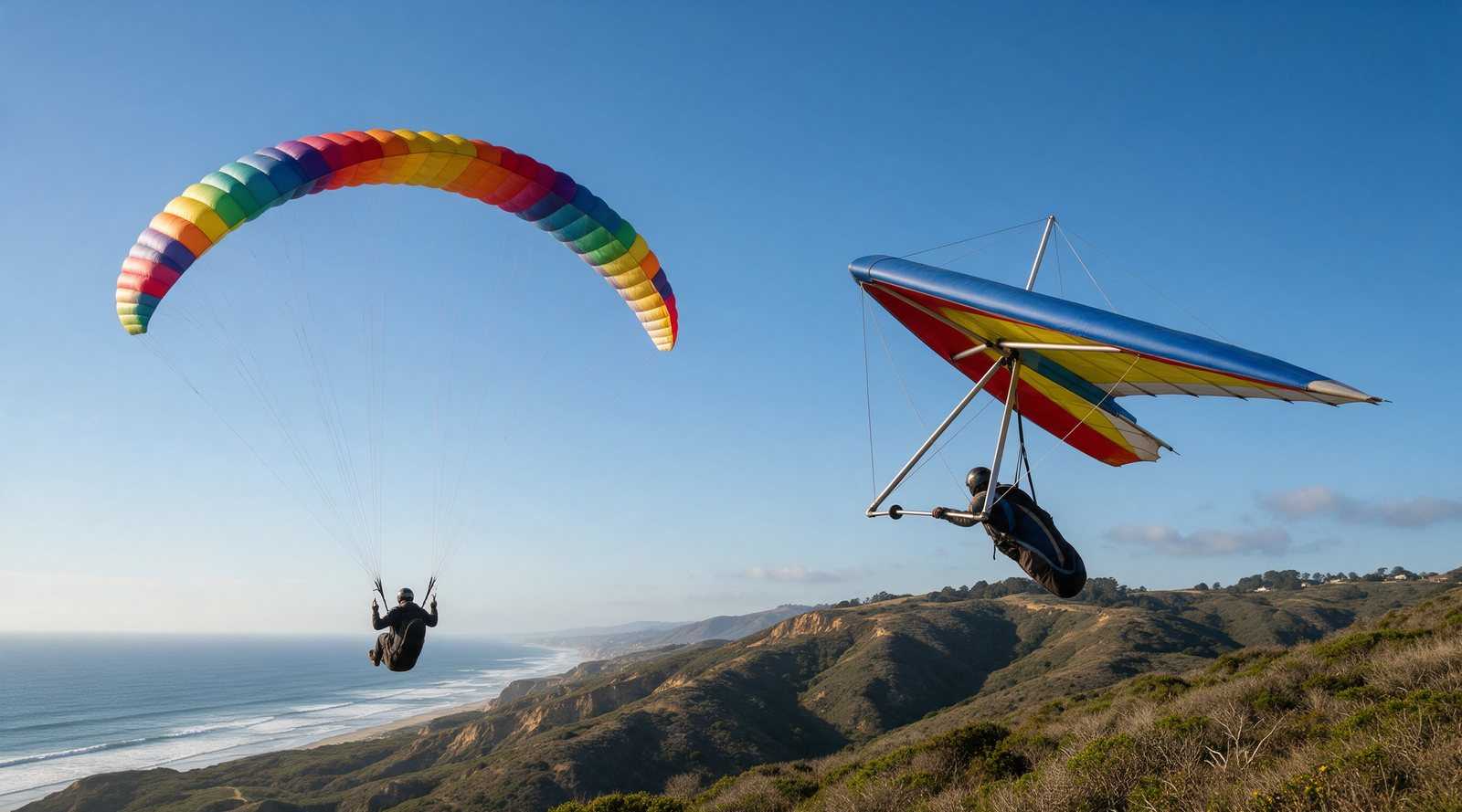
Hang gliders are faster, glide farther and handle stronger wind. Paragliders are lighter, pack into a backpack and need less room to launch and land. Both are foot-launched, engine-free gliders taught through the same USHPA rating system, and the right choice depends on where you live, how you like to travel and what kind of flying you want.
Our club, Sonoma Wings, has hang glider and paraglider pilots flying the same Sonoma County sites, so this comparison is written from both sides. For a full introduction to each sport, see our hang gliding guide and paragliding guide.
The basic difference
A hang glider has a rigid aluminium or composite frame covered with sailcloth. The pilot lies prone in a harness, holds a triangular control bar, and steers by shifting weight. A paraglider has no frame at all. Its fabric wing is inflated by air entering cells along the leading edge, and the pilot sits in a harness hanging on lines below, steering with brake toggles and weight shift.
As Fly With Jordan, a Southern California school, puts it, the hang glider resembles a fixed-wing aircraft while the paraglider looks more like a parachute. That one structural difference drives almost every other trade-off below.
Side-by-side comparison
| Hang glider | Paraglider | |
|---|---|---|
| Wing structure | Rigid frame with fabric sail | Fully flexible fabric wing, no frame |
| Pilot position | Prone, head first | Seated or reclined |
| Typical speed range | About 18 mph min-sink to 48-53 mph never-exceed (Wills Wing placards) | About 14 to 34 mph, trim 20 to 25 mph |
| Glide ratio | About 9.5:1 recreational to 16.5:1 competition; rigid wings about 20:1 | About 9.3:1 recreational to 11.3:1 competition |
| Glider weight | About 54 to 70 lb for a Wills Wing Sport 2 | Wing 3 to 7 kg (7 to 15 lb); full kit about 12 to 22 kg |
| Packed size | About 11 to 18 ft long, carried on a roof rack | Fits in a large backpack |
| Landing area | Flat area of roughly 15 to 60 m | Smallest space of any glider |
| Distance record | 764 km (2012, Texas) | 609.9 km (2021, Texas) (record as of 2025) |
| Wing lifespan | Can last decades | Often estimated around 500 flying hours |
Sources: speeds and weights from Wills Wing placard and Sport 2 specifications; glide, landing, lifespan and paraglider figures from Wikipedia’s hang gliding and paragliding articles; hang gliding record from Wills Wing.
Speed and wind range
Speed is the hang glider’s biggest advantage. A paraglider’s top speed with full speed bar is around 34 mph, and its hands-off cruise is in the low 20s. Wind much stronger than that and a paraglider simply goes backward. Hang gliders cruise faster and have a top end in the high 40s to low 50s mph, so they can penetrate into stronger wind and cross gaps between thermals more quickly.
You see this on real sites. Torrey Pines Gliderport says hang gliders do better in stronger wind, with spring and summer favoring hang gliding and the lighter winds of fall and winter favoring paragliding. On our coast at Goat Rock, the site guide warns that wind can pick up quickly and blow the site out, especially for paragliders.
The flip side is that paragliders fly slowly in light air, which makes them easy to launch on calm days and lets them turn very tightly in small thermals.
Glide performance and cross-country
A hang glider glides farther for each foot of height lost. Recreational wings of both types start near 9.5:1, but competition hang gliders reach about 16.5:1 and rigid wings about 20:1, against roughly 11:1 for competition paragliders. Better glide means reaching the next thermal or landing field from farther away, which is a real safety margin at sites with long glides out. Our St Helena guide warns of a 6:1 glide out over vineyards with few safe landing spots.
Paragliders still fly huge distances. The two straight-distance records are both from Texas, at 764 km for hang gliders and about 610 km for paragliders, and our own site records list long cross-country flights in both wings from local hills.
Portability, launch and landing
This is where paragliding wins. The whole paragliding kit fits in a backpack, so pilots can hike to launch, fly, land in a small field miles away and get a ride back, a pattern Fly With Jordan describes in its comparison. Paragliders need the smallest landing area of any glider.
A hang glider is a long bundle of tubes and sail that rides on a car roof. Setting up and breaking down takes longer, and you need a flat landing area of roughly 15 to 60 meters. Launch involves running with a glider of 50 to 70 pounds on your shoulders. Windy cliff launches can also need helpers, called wire crew, to steady the glider; Goat Rock’s guide notes that wiremen are needed there in soarable conditions.
On the other hand, a paraglider has to be laid out, inflated and controlled overhead before every launch, which takes practice in gusty or crossing wind.
Learning curve
Paragliding is widely described as the simplest and quickest of the free-flight sports to learn. The wing is light and it launches from gentle slopes. Hang gliding training is more physical. You carry the glider back up the training hill after each flight, and landings require a well-timed flare to stop the glider.
Neither is a weekend skill. Torrey Pines describes its P2 Novice program as a 160-hour curriculum that most students complete in 15 to 20 days. Hang gliding schools such as Mission Soaring Center sell lessons as packages of four-hour days, and how many you need depends on weather and progress. Both sports use the same five-level USHPA system: H1 to H5 for hang gliding and P1 to P5 for paragliding, as listed on the USHPA Become a Pilot page. Our USHPA ratings guide and learn to fly page go further.
Safety considerations
The two wings fail in different ways. A paraglider’s shape depends on internal air pressure, so turbulence can collapse part of the wing. Modern beginner wings usually recover on their own, but a collapse close to the ground can leave no time to throw a reserve, as Wikipedia explains. A hang glider’s frame holds its shape in rough air, but the glider flies faster, so a misjudged launch or landing carries more energy.
In both sports, most accidents come down to judgment: flying in conditions beyond your skill, or getting low near terrain. The same habits protect you in either wing. Train with a certified instructor, fly a wing suited to your rating, carry a reserve, check the weather (see our weather links), and follow site rules. We look at this in more depth in is hang gliding safe?.
Cost
Starting costs are closer than many people expect. Paragliding training at Torrey Pines ran $2,800 to $3,800 for a P1 plus P2 package in 2026. On the hang gliding side, Mission Soaring listed single lessons at $180 and a five-lesson package at $800, and Windsports charged $115 to $175 for a beach lesson.
For gear, a US dealer put a complete new paragliding setup at $4,500 to $7,500 in 2026, according to Paragliding Equipment. A new intermediate hang glider alone listed at $5,075, before harness, reserve and instruments. Over time, durability shifts the picture: Fly With Jordan notes hang gliders can last for decades while a paraglider wears out after a few years of use. Tandems are similar too. Torrey Pines listed paragliding tandems at $200, and Windsports’ mountain hang gliding tandems at Sylmar were $350. Our hang gliding cost guide has the full breakdown.
Which suits you?
Paragliding tends to suit people who want to hike and fly, travel with their wing, or live far from a dedicated hang gliding site. It is also easier to store in an apartment and to take on a plane.
Hang gliding tends to suit people who want more speed and glide, enjoy windier coastal sites, and don’t mind roof-racking a glider.
The best test is a tandem in each. In California, our flying sites directory lists places like Torrey Pines Gliderport and Fort Funston, and our dealers and training page lists Northern California schools for both wings. Once you have a rating, come fly with us at Goat Rock and St Helena, where both wings share the same sky.
Frequently asked questions
Is hang gliding or paragliding harder to learn?
Paragliding is usually quicker to start, since the wing is light and launches from small slopes, and it is widely considered the simplest and quickest free-flight sport to learn. Hang gliding asks more of you physically on launch and landing, with a heavier glider and a run-and-flare landing. Both take many lesson days to reach a Novice rating, and both take years to master.
Which is safer, hang gliding or paragliding?
Neither is risk-free, and the risks differ. A paraglider's fabric wing can collapse in turbulence, while a hang glider's rigid frame keeps its shape but flies faster, so launches and landings carry more impact. Training, matching your wing to your rating, carrying a reserve and choosing conditions well matter far more than which wing you pick.
Which is more fun, hang gliding or paragliding?
It depends on what you value. Paraglider pilots love hiking up with a wing in a backpack and landing almost anywhere. Hang glider pilots love the speed, the prone Superman position and the longer glide. Try a tandem in each before you commit to training.
Is a hang glider or a paraglider cheaper?
Entry costs are similar. A complete new paragliding setup ran about $4,500 to $7,500 in 2026, and a new intermediate hang glider alone listed around $5,000. Hang gliders can last for decades, while a paraglider wing is often estimated to last around 500 flying hours, so long-term costs can favor hang gliding.
Can you fly both a hang glider and a paraglider?
Yes. USHPA issues separate H and P ratings, and plenty of pilots hold both. Many California sites, including our club's Goat Rock and St Helena sites, are open to both wings under the same rules.
Sources
- Hang gliding (Wikipedia), comparison of hang gliders, paragliders and gliders
- Paragliding (Wikipedia)
- Wills Wing: Hang Glider Placard Specifications
- Wills Wing: Sport 2 / 2C specifications
- Wills Wing: Dustin Martin's World Record Flight
- Fly With Jordan: Hang Gliding vs Paragliding
- Torrey Pines Gliderport: Tandem Hang Gliding
- Torrey Pines Gliderport: Tandem Paragliding
- Torrey Pines Gliderport: Beginner and Novice Certification P1-P2
- Windsports: beach lessons and mountain tandems
- Mission Soaring Center: lesson overview and prices
- Paragliding Equipment (Let's Go Paragliding): How much does a paraglider cost
- USHPA: Become a Pilot
- Sonoma Wings site guides (Goat Rock, St Helena)