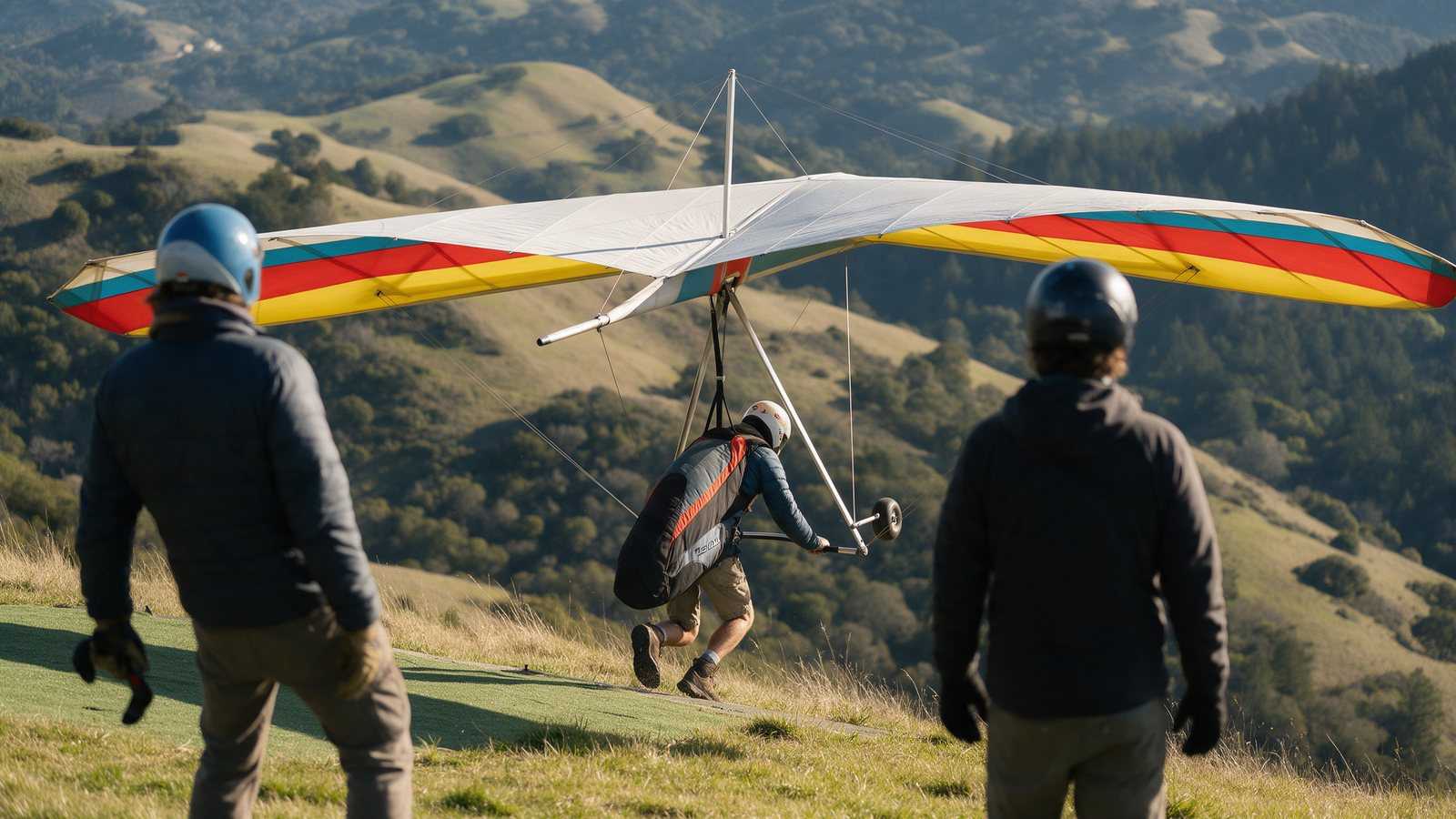
USHPA, the United States Hang Gliding and Paragliding Association, is the national organization that issues pilot ratings for hang gliding, paragliding and speed flying in the US. Its rating ladder runs from Beginner (H1/P1) to Master (H5/P5), and the rating you hold decides which flying sites you may use and when you need supervision there. This page explains what USHPA does, what membership costs and covers, what each rating means, and why sites like ours ask to see your card.
What USHPA is
USHPA describes itself as a 501(c)(3) non-profit dedicated to hang gliding, paragliding and speed flying. It was founded in California, is now based in Colorado Springs, and is run by an executive director with a volunteer board of eight elected and two appointed directors (About USHPA). It began in the 1970s as the USHGA, the United States Hang Gliding Association, which is why older pilots (and our own membership form) still say “USHGA number” (USHPA).
USHPA is not a government agency. Hang gliders and paragliders flown solo are ultralight vehicles under FAR Part 103, and no FAA pilot certificate is required (USHPA FAA Resources). USHPA does hold the FAA exemptions that make instructional tandem flights and aerotowing legal, which is one reason the whole training system runs through it.
Membership levels and what they cost
USHPA lists these membership levels (checked October 2026):
- Temporary, 10 days: $6
- Student, 60 days: $50
- Contributing (non-flying): $82 per year
- Pilot (flight-rated): $199 per year
- Rogallo (certified instructors and appointed officials): $425 per year
Source: USHPA Become a Pilot. New members join online, but a current USHPA instructor has to activate the membership. There is also a one-time $15 fee to register each rating in the USHPA system (USHPA FAQ).
What membership covers
USHPA lists participant and third-party liability insurance, access to certified instructors, support from more than 50 local chapters, partner discounts, and the USHPA Pilot magazine among member benefits (About USHPA). The Pilot level includes third-party liability insurance, and the Rogallo level adds coverage for instructors under specific conditions (USHPA FAQ). The detailed policy terms are behind the member login, so read them in your account rather than relying on a summary.
The insurance matters to every pilot, not just the one buying it. USHPA explains that each member signs a liability waiver and carries insurance, which combines with the landowner’s coverage. If an uninsured, non-waivered pilot causes an incident, the landowner’s coverage may not apply as expected, which puts the site at risk (USHPA FAQ).
The rating levels, H0/P0 to H5/P5
USHPA uses the same five-level structure for each wing type: H for hang gliding, P for paragliding and S for speed flying. The descriptions below are condensed from USHPA’s Ratings and Skills page.
H0/P0: Student
A Student understands and accepts the risks of flying as a tandem passenger. This rating satisfies the FAA tandem exemption.
H1/P1: Beginner
The pilot can take off, fly in a straight line and land, and knows the basics of setup and breakdown. A Beginner is not ready to fly independently.
H2/P2: Novice
The Novice has learned turns, maneuvering and landings, has flown from higher ground under supervision, and has shown confident handling in flight and in stronger winds. They have had training in meteorology, air movement, clouds and FAA regulations. USHPA says a P2 pilot can fly and practice without direct instructor supervision, but within significant operating limitations.
Those limitations are real. Paragliding San Francisco’s P2 study guide, based on USHPA’s recommended operating limitations, tells new P2 pilots to avoid thermals averaging more than 200 feet per minute and to launch only in base winds up to 12 mph with gusts no higher than 15 mph (P2 study guide). Confirm the current limits with your instructor, since the official text sits in USHPA’s members-only operating procedures.
H3/P3: Intermediate
The Intermediate pilot has more flight experience and training in decision making, weather forecasting, micrometeorology and airspace. The focus at this level is judging sites and conditions correctly. Many coastal and mountain sites list H3/P3 as their minimum for unsupervised flying.
H4/P4: Advanced
Advanced pilots can handle conditions at a wide range of sites and know when not to fly. They often mentor newer pilots, and at some sites they can close the site or limit flying if conditions are unsafe for lower-rated pilots. USHPA says Advanced pilots are eligible for instructor certifications (for hang gliding, a Basic Instructor needs at least an H3).
H5/P5: Master
A Master has shown outstanding skill over a long period, on many sites, wings and launch methods, has received a Bronze Safe Pilot Award, and has the endorsement of other pilots.
Special skills and sign-offs
Ratings describe overall skill. Special skills, sometimes called sign-offs, cover specific techniques, and many sites require one or more of them. USHPA’s lists include, among others (Ratings and Skills):
- Hang gliding: Aero Tow Launch (AT), Surface Tow (ST), Foot Launch (FL), Cliff Launch (CL), High Altitude Launch (HA), Restricted Landing Field (RLF), Turbulence (TUR), Cross Country (XC), and tandem skills.
- Paragliding: Cliff Launch, Flat Slope Launch, High Altitude Launch, Ridge Soaring (RS), Turbulence, Cross Country, Mini Wing 1 and 2 (M1, M2), and tandem skills.
Mini wing sign-offs are a good example of why sign-offs matter locally: our Goat Rock site guide does not allow mini wings at all, regardless of M1 or M2.
Who can issue ratings: instructors and observers
Ratings are granted by USHPA rating officials after you demonstrate the required skills and pass written tests, with minimum numbers of flights and hours at each level (USHPA Become a Pilot).
- Basic Instructors can issue ratings 0 to 2 and any special skills they hold.
- Advanced Instructors and Observers can issue ratings 3 and 4 and special skills they hold.
Observers exist for areas without a local instructor. According to USHPA, an Observer must have held an H3/P3 or higher rating for at least a year and is appointed by an Instructor Administrator. Observers can issue Intermediate and Advanced ratings, administer tests and recommend pilots for the Master rating, but cannot rate themselves or issue tandem or towing ratings unless separately certified (USHPA Certifications).
This is where clubs come in. Making the rating system accessible to local pilots is one of Sonoma Wings’ stated goals, and we have USHPA Observers in the club (About Sonoma Wings). If you are working toward H3/P3 or H4/P4, ask at a club meeting.
Why flying sites require ratings
Site rules tie ratings to the specific hazards of each launch and landing zone, and to the site’s insurance and landowner agreements. Our own guides show how much requirements vary:
- Goat Rock: USHPA membership required. A Sonoma Wings H4/P4 must be present to open the site, experienced H3/P3 members can fly on their own, and H2/P2 members may fly the north end only with an H4/P4 sponsor on the ground.
- St. Helena: H4/P4, or H3/P3 if sponsored by a Sonoma Wings member.
- Elk Mountain: public land with no required rating, but H3/P3 is recommended and H2/P2 pilots should fly with supervision.
- Hull Mountain and St. John: public land with no required rating, but local consensus treats them as H3-minimum and H4 sites.
Other California sites are stricter. Torrey Pines Gliderport requires a P3 with 50 hours or an H4 rating for visiting pilots, and lets P2 and H3 pilots fly only under instructor supervision (Torrey Pines Gliderport). Our California flying sites directory lists the required rating for each site we cover.
Flying abroad
USHPA members with active ratings get an IPPI conversion printed on their digital membership card, so they no longer need a separate IPPI card to show international equivalency (Ratings and Skills). Foreign sites and clubs can still ask for logbooks and their own checks.
Getting started
If you have not flown yet, start with our guide to learning to fly, which covers tandems, training hills and choosing a school. For the cost of membership, lessons and gear together, see what hang gliding costs.
Frequently asked questions
What does USHPA stand for?
USHPA is the United States Hang Gliding and Paragliding Association, a 501(c)(3) non-profit based in Colorado Springs. It started as the USHGA (United States Hang Gliding Association) and runs the national pilot rating program, instructor certification, and the insurance that most US flying sites depend on.
What does a P2 rating allow you to do?
A P2 (Novice) paraglider pilot has the knowledge and basic skills to fly and practice without direct instructor supervision, within significant operating limitations. Many managed sites still require P3 or supervision for P2 pilots, so check each site's rules before you fly.
How do you get an H2 rating?
Train with a USHPA-certified instructor until you meet the Novice requirements: a minimum number of flights and airtime, demonstrated skills such as turns, landings and higher-altitude flights under supervision, and a written test. Basic Instructors can issue ratings up to H2/P2. After the instructor signs you off, you accept and pay the one-time $15 rating fee in your USHPA account.
How much is a USHPA membership?
As listed by USHPA in October 2026: a 10-day temporary membership is $6, a 60-day student membership is $50, an annual Pilot membership is $199, and the instructor-level Rogallo membership is $425 a year. Non-flying contributing members pay $82 a year. Prices change, so check ushpa.org before joining.
Are USHPA ratings recognized in other countries?
USHPA members with active ratings get an IPPI conversion printed on their digital membership card, so they can show an international equivalent when flying abroad. Foreign sites may still set their own requirements.
Do you need a USHPA rating to fly a paraglider?
Federal law does not require one; solo hang gliders and paragliders fly under FAR Part 103. But nearly every insured flying site requires USHPA membership and a minimum rating, because the site's insurance and landowner agreements depend on it.
Sources
- USHPA: About USHPA
- USHPA: Ratings and Skills
- USHPA: Become a Pilot (membership levels and rating program)
- USHPA: Frequently Asked Questions
- USHPA: Certifications and Appointments (instructors and observers)
- USHPA: About Free Flight Aviation
- USHPA: FAA Resources
- Paragliding San Francisco: USHPA P2 Test Study Guide
- Torrey Pines Gliderport: Visiting Pilot requirements