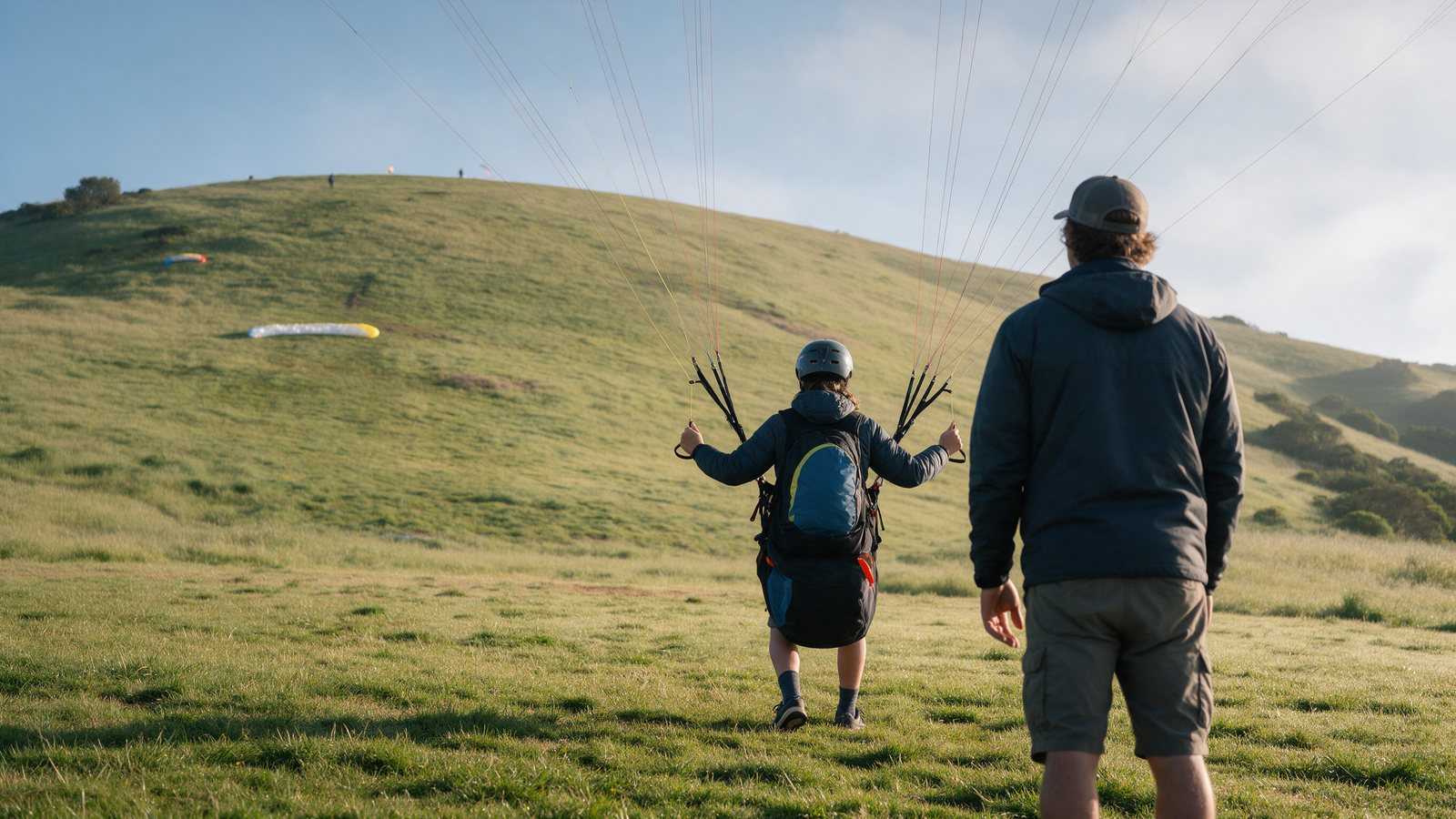
Learning to hang glide or paraglide usually starts with a tandem flight, moves to a gentle training hill where you make dozens of short solo hops, and ends with supervised flights from higher launches until an instructor signs you off for the Novice rating (H2 for hang gliding, P2 for paragliding). Most schools say this takes somewhere between one and three weeks of lesson days, spread over however many weekends the weather allows. Here is how the process works, what to look for in a school, and how a local club like ours fits in once you have your rating.
Step 1: Take a tandem flight
A tandem flight puts you in the air with a certified tandem instructor on a glider built for two. The instructor handles launch and landing, and on most flights you get to hold the controls for part of the time. Wills Wing describes tandem as the easiest and most comfortable way to find out what flying feels like, and on later lessons tandems are used to teach turns, speed control and landing approaches (Wills Wing).
Tandem is also how you find out which sport suits you. If you are undecided, our hang gliding vs paragliding comparison covers the differences in gear, wind range and feel.
A legal point worth knowing: in the US, tandem flights are flown under USHPA’s FAA tandem exemption, which covers instructional flights only. Both people on the wing have to be USHPA members, so a first-time passenger signs a 10-day temporary membership on the day (USHPA FAQ).
Step 2: Ground school and the training hill
Once you sign up for a lesson program, the real work starts on the ground. You learn to set up and preflight the wing, and paragliding students spend hours on ground handling (kiting the wing overhead in the wind) before they ever leave the ground.
Then comes the training hill. Wills Wing explains that you launch yourself by running down a small, gently sloping hill, and on your first flights you will be only a few feet above the ground with an instructor beside you (Wills Wing). Flat sand dunes serve the same purpose at some schools. The aim is hundreds of launches and landings at low height, because launching and landing are where most training mistakes happen.
Expect a lot of repetition. Windsports in Los Angeles says students fly 10 to 15 times per beach lesson (Windsports), and Lookout Mountain Flight Park’s longest hang gliding package includes 75 training hill flights before the Novice rating (Lookout Mountain Flight Park).
Step 3: Higher hills, radios and first real flights
After you can launch, fly straight, turn and land consistently, your instructor moves you to a higher launch for longer flights. An instructor on the radio talks you through new maneuvers and your landing approach. This is the stage where you start to understand how wind flows over terrain and how to plan a landing pattern.
You also pick up the first of USHPA’s Beginner rating (H1 or P1) along the way. USHPA defines a Beginner as a student who can take off, fly straight and land, and who understands basic glider setup, but is not yet ready to fly independently (USHPA Ratings and Skills).
Step 4: Towing and aerotow (where there are no hills)
Not every school has a mountain. In flat country, pilots are towed aloft instead: behind an ultralight aircraft (aerotow), behind a vehicle or boat, or by a stationary winch. Wills Wing notes that scooter towing, where a motor scooter acts as a stationary winch, has become a refined training tool (Wills Wing).
Each tow method is its own skill. USHPA lists separate special skills for Aero Tow Launch (AT) and Surface Tow (ST), and aerotowing is flown under a separate FAA exemption (USHPA FAA Resources). If you train at a tow park, you will need a foot launch sign-off before you can fly from hill sites like ours, so ask your school which launch skills its program covers.
Step 5: The Novice rating (H2 or P2)
The Novice rating is the goal of most beginner programs. USHPA says a Novice has learned turns, maneuvering and landings, has flown from higher ground under supervision, handles the glider confidently in flight and in stronger wind, and has had training in meteorology and FAA regulations. A Novice paraglider pilot can fly and practice without direct instructor supervision, but within significant operating limitations (USHPA Ratings and Skills).
To earn it you need a minimum number of flights and airtime plus a written test, and the rating is granted by a certified instructor (USHPA Become a Pilot). The exact minimums are in USHPA’s standard operating procedures, which are members-only, so ask your instructor for the current checklist. Our USHPA ratings guide explains each level from H1/P1 to H5/P5.
How many lesson days to H2 or P2?
Schools publish different numbers because programs and weather differ. Here is what four US schools say on their own pages (checked October 2026):
- Lookout Mountain Flight Park (Georgia) says its Eagle hang gliding package can take you to H2 “in as little as a week to ten days” (Lookout Mountain).
- Windsports (Los Angeles) says the H1 usually takes 5 full beach lessons, and that students typically reach H2 after about 5 advanced beach lessons, 5 mountain tandems and 8 mountain solo flights (Windsports).
- Eagle Paragliding (Santa Barbara) says most P2 students finish in 10 to 11 days (Eagle Paragliding).
- Torrey Pines Gliderport (San Diego) says its P1+P2 curriculum is 160 hours, with 30 to 45 flights for the P2 portion, and takes most students 16 to 20 days. The school also warns against programs that promise a P2 in 7 days (Torrey Pines Gliderport).
Plan on the calendar time being longer than the lesson-day count. Lessons get cancelled for wind, rain and fog, and coastal Northern California has plenty of all three.
How to choose a USHPA-certified school
USHPA’s advice is to find a current USHPA-certified instructor, who will activate your student membership and teach you the basics. Its checklist: is the instructor a USHPA member with an active instructor certification, what seasons work best at their training site, and do they also offer tandems, gear advice, tours and clinics (USHPA Become a Pilot). USHPA runs an online instructor search for this.
A few more questions worth asking before you pay:
- How many training days are included, and what happens if you need more? Some programs are open-ended, others bill per day after a set number.
- Is gear included during training, and does the package price depend on buying your first wing from the school? Several schools price it that way. Our hang gliding cost guide has current examples.
- What is the student-to-instructor ratio on the training hill?
- Does the training site match where you will fly afterward? Coastal ridge soaring, inland thermal sites and tow parks each teach different habits.
- Which launch skills will you leave with (foot launch, tow, cliff launch)?
Visit the training hill before you sign up if you can. Watching a lesson for an hour tells you a lot about how a school runs.
What to expect on lesson days
Lesson days are long and physical. You will carry gear up the training hill many times, and you will spend a lot of time waiting for the wind to be right. Bring water, food, sun protection, sturdy over-the-ankle boots, and clothes you do not mind getting dirty. Schools supply the glider, harness and helmet during training.
Expect to be tired, and expect some days with no flying at all. Instructors who cancel for marginal conditions are doing their job. Our page on whether hang gliding is safe covers why weather judgment is the single biggest skill you are learning.
Students under 18 should check age rules first. USHPA requires tandem and solo students to be at least 14 and solo-rated pilots to be at least 16 (USHPA Become a Pilot).
After your rating: how a local club helps
A Novice rating is a license to keep learning. New pilots progress fastest when they fly with experienced pilots at sites they know, and that is what clubs are for.
Sonoma Wings administers flying sites in Sonoma County, covers safety at every club meeting, and has USHPA Observers among its members who can help pilots work toward Intermediate and Advanced ratings (see about our club). Several of our sites have a supervised path for new pilots. At Goat Rock, for example, Sonoma Wings H2/P2 members can fly the north end with an H4/P4 sponsor on the ground, and our Elk Mountain site guide recommends some supervision for H2/P2 pilots.
To fly with us, see how to join Sonoma Wings and come to a club meeting. For instructors and shops, our dealers and training page lists contacts that pilots have used over the years; the listings are older, so confirm that a school is still operating and that its instructors hold current USHPA certification before you book.
Once you are rated and want to travel, our California flying sites directory lists the rating each site requires.
Frequently asked questions
How long does it take to learn hang gliding?
Most schools quote one to three weeks of lesson days to reach the Novice (H2 or P2) rating that lets you fly without an instructor at suitable sites. Lookout Mountain Flight Park says its H2 package can take as little as a week to ten days, Eagle Paragliding says most P2 students finish in 10 to 11 days, and Torrey Pines says its P1+P2 program takes most students 16 to 20 days. Weather and how often you can get to lessons usually matter more than talent.
Is there tandem hang gliding?
Yes. Tandem hang gliders carry an instructor and a student, and many schools use tandem flights both as a first experience and as part of pilot training. In the US, instructional tandems are flown under USHPA's FAA exemption, so both people on the glider must be current USHPA members (a 10-day temporary membership covers a first-time passenger).
Is hang gliding or paragliding harder to learn?
Neither is easy, and they are hard in different ways. Paragliders pack into a backpack and fly slower, which is why the Chattanooga Hang Gliding and Paragliding Association notes that most new pilots choose paragliding. Hang gliders are heavier to carry and set up but give very direct control and handle stronger wind. Try a tandem in each before you commit to a training program.
Do you need a pilot's license to hang glide?
No FAA pilot certificate is required. Solo hang gliders and paragliders are flown under FAR Part 103, the ultralight vehicle rule. In practice you need a USHPA rating, because almost every managed flying site, including the ones our club runs, requires USHPA membership and a minimum rating.
How old do you have to be to take hang gliding lessons?
USHPA's age policy says tandem and solo student pilots must be at least 14, and you must be 16 to earn solo ratings. Individual schools can set higher limits; Windsports, for example, requires mountain tandem passengers to be 18.
Sources
- USHPA: Become a Pilot
- USHPA: Ratings and Skills
- USHPA: Frequently Asked Questions
- USHPA: FAA Resources (Part 103, tandem and aerotow exemptions)
- Wills Wing: Instruction
- Windsports: Pilot Training Program
- Torrey Pines Gliderport: Beginner to Novice Certification P1-P2
- Eagle Paragliding: P2 Certification
- Lookout Mountain Flight Park: Learn to Hang Glide
- Chattanooga Hang Gliding and Paragliding Association: Learn to Fly