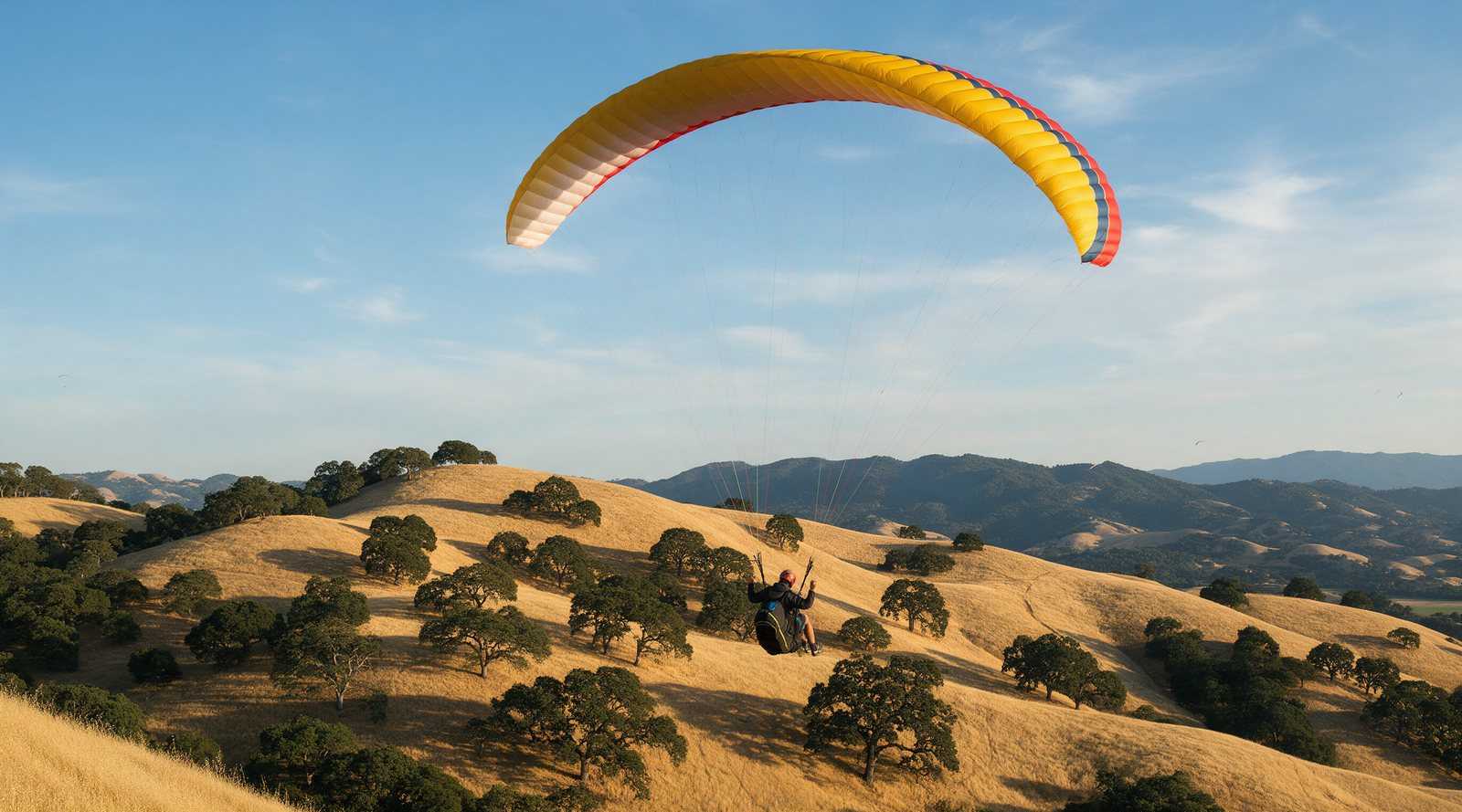
Paragliding is foot-launched, engine-free flight under a soft fabric wing that you can fold into a backpack. A paraglider has no rigid frame: air entering the front of the wing inflates it into an airfoil, and the pilot sits in a harness below, steering with brake toggles and weight shift. Most people start with a tandem flight or an intro day, then train for a USHPA Novice (P2) rating, which lets them fly on their own at many sites.
We are Sonoma Wings, a hang gliding and paragliding club in Sonoma County, California. This guide covers how a paraglider flies, what gear you need, how training and ratings work, rough 2026 costs, the safety picture, and where to fly in California.
What is paragliding?
Paragliding means flying lightweight, free-flying, foot-launched gliders with no rigid primary structure. The pilot sits in a harness, or a cocoon-like pod, suspended under a fabric wing. Without an engine, paraglider flights can last many hours and cover hundreds of kilometers, though one to five hours and a few tens of kilometers is more typical.
In the US, a solo paraglider is an unpowered ultralight. 14 CFR 103.1 covers single-occupant recreational vehicles under 155 pounds, and 14 CFR 103.7 says no pilot or medical certificate is needed. The structure comes from the United States Hang Gliding and Paragliding Association (USHPA): certified instructors, P1 to P5 ratings, and site rules that require them.
Paragliding is different from parasailing, where you are towed behind a boat the whole time, and from paramotoring, which adds a small engine on your back and needs extra training on top of regular paragliding.
How a paraglider wing works
The ram-air wing
A paraglider is a ram-air airfoil. Two layers of fabric are joined by internal ribs into a row of cells. The cells are open near the leading edge, so incoming air keeps the wing pressurized and gives it the teardrop shape of an airfoil. Modern wings use non-porous ripstop nylon, and nearly all now use a “sharknose” leading edge that improves stability.
Below the wing, thin lines made of aramid or UHMW polyethylene run down to four short straps called risers, which clip to the harness with carabiners. Lines are grouped in rows from front to back: A, B, C and sometimes D. A typical wing has 20 to 35 square meters of area, spans 8 to 12 meters and weighs 3 to 7 kg.
Controls
Paraglider pilots use three main controls. Brake toggles in each hand pull down the trailing edge on that side, which slows the wing, steers it, and flares it for landing. Weight shift in the harness helps the wing turn and is used together with the brakes. A foot-operated speed bar lowers the wing’s angle of attack to fly faster than trim speed. Pilots also learn descent techniques such as “big ears,” where folding the wingtips raises the sink rate to about 2.5 to 3.5 meters per second.
Speed and glide
A typical paraglider flies at 22 to 55 km/h (14 to 34 mph) from stall to full speed, with hands-off trim speed around 32 to 40 km/h (20 to 25 mph). Glide ratios run from about 9.3:1 for recreational wings to around 11.3:1 for modern competition wings, occasionally up to 13:1. A skydiving canopy, for comparison, glides about 3:1.
That modest speed is the paraglider’s main limit. It means a paraglider can be blown backward in wind that a hang glider handles easily. Our Goat Rock site guide warns that coastal wind can pick up quickly and leave the site blown out, “especially for paragliders.”
Staying up: ridge lift and thermals
Like any glider, a paraglider is always sinking through the air. To stay up, pilots fly in air that rises faster than that. Ridge soaring uses wind deflected up a slope or cliff; pilots fly back and forth along the face. Thermal flying uses columns of warm air rising from sun-heated ground; pilots circle to climb, often to cloud base, then glide to the next thermal to fly cross-country. A variometer that beeps as you climb helps you center thermals.
Our club’s own site records show what thermals can do from a local hill: a paraglider has flown 66 miles from Mt. St. Helena to Elk Creek.
Paragliding gear
The wing
Wings are certified to the European EN 926 standard and grouped into classes. A paragliding buying guide summarizes them: A is the school and beginner wing, B covers intermediate pilots, C is a sport wing for long-distance pilots who fly a lot, and D is a performance wing for very experienced competitors. A wing takes the highest class it scores in any single test, so a wing with one B result is a B. New pilots fly an EN-A or a low EN-B wing, and an instructor should sign off on the choice.
Harness and reserve
The harness is your seat, back protection and gear bag. Most harnesses use foam or airbag protectors under the seat and back. Beginners use an open, seated harness; pod harnesses for cross-country flying are more aerodynamic but are not recommended for beginners because of riser-twist risk. Every harness carries a reserve parachute. Most pilots never throw theirs, but it is mandatory gear for a reason.
Instruments, radio and the rest
A variometer with altimeter is the basic instrument, and many pilots add GPS or a phone flight app. Students are coached by radio on early flights. Add a helmet, gloves, sturdy boots and layers. A full kit of wing, harness, reserve, instruments and helmet typically weighs about 12 to 22 kg, and ultralight hike-and-fly setups can come in under 5 kg.
How to learn paragliding
Tandem first
Most schools offer tandem flights so you can see whether you like it. At Torrey Pines Gliderport in San Diego, a tandem paragliding flight cost $200 in 2026, first come, first served, with no reservations because flights depend on wind. Under USHPA’s FAA tandem exemption, the USHPA FAQ says both people on board must be USHPA members; passengers can use a short temporary membership.
Ground handling and the training hill
Real training starts on the ground. You learn to lay out the wing, inflate it, keep it overhead and control it in wind, which pilots call ground handling or kiting. Then you make short flights from a gentle slope, then longer flights from higher launches with an instructor on the radio. Expect classroom time on weather, airspace and site rules too. USHPA’s training resources page lists the standard textbooks, including Dennis Pagen’s The Art of Paragliding and Mike Meier’s Paragliding: A Pilot’s Training Manual.
How long it takes
It depends on the school and the weather. Torrey Pines describes its P1 program as 5 to 6 days (about 40 hours) with 5 to 8 flights, and its P2 program as a 160-hour curriculum most students finish in 15 to 20 days, with 30 to 45 flights. The school also warns against programs that promise a P2 in a week. Some schools, like Penguin Paragliding in Northern California, run frequent short classes you join as your schedule allows. Our learn to fly guide covers choosing a school.
USHPA paragliding ratings: P1 to P5
USHPA uses five rating levels for paragliding, mirroring hang gliding. The USHPA Become a Pilot page lists them from P1 Beginner to P5 Master, with requirements for minimum flights, airtime and written tests.
- P1 Beginner: you can launch, fly straight and land under instruction.
- P2 Novice: you can turn, plan an approach and fly higher sites; this is the rating schools such as Torrey Pines and Penguin describe as the level for flying without an instructor at regulated sites.
- P3 Intermediate: more experience, better judgment of sites and conditions, more weather and airspace knowledge.
- P4 Advanced: experienced pilots who can fly demanding sites and often sponsor guests at club sites.
- P5 Master: long experience on many sites, wings and conditions.
USHPA requires students to be at least 14 and solo-rated pilots to be at least 16. Site rules are stricter than the rating itself at many places. At Goat Rock, our club allows P2 pilots on the north end only with a P4 sponsor on the ground. At St Helena, the minimum is P4, or P3 if sponsored by the club. See our USHPA ratings guide for the details of each level.
What paragliding costs
Prices below are 2026 figures from the sources linked.
| Item | Typical price | Source |
|---|---|---|
| Tandem flight | $200 | Torrey Pines Gliderport |
| P1 Beginner program | $1,700 | Torrey Pines Gliderport |
| P2 Novice program | $2,100 | Torrey Pines Gliderport |
| P1 + P2 combo | $2,800 with gear purchase, $3,800 without | Torrey Pines Gliderport |
| New beginner wing | about $3,000 to $5,500 | Paragliding Equipment (US dealer) |
| Harness | $500 to $1,500 | Paragliding Equipment |
| Reserve parachute | $500 to $1,200 | Paragliding Equipment |
| Complete new setup | $4,500 to $7,500 | Paragliding Equipment |
| USHPA annual pilot membership | $199 | USHPA |
A US gear dealer puts a used wing at around $1,500, and suggests buying through your instructor so the gear is checked and suits your level. Wings also wear out: Wikipedia estimates a paraglider lasts around 500 flying hours depending on care, far less than a hang glider. Our hang gliding cost page compares the two sports’ costs in more depth.
Is paragliding safe?
Paragliding has real risks. Because the wing has no frame, turbulent air can collapse part or all of it. Modern beginner wings usually recover on their own, and training teaches pilots to fly “actively” to prevent collapses. A collapse close to the ground is the dangerous case, since there may be no time to throw a reserve. Wikipedia cites a US fatality rate of about one in 5,000 pilots in 2010, and notes that many accidents come from a mix of pilot error and poor conditions.
The habits that lower the risk are the same at every site: train with a certified instructor, fly a wing in the right class for your skill, carry a reserve, wear a helmet and a protective harness, check the forecast (our weather links help), and stay on the ground when the wind is too strong. Many pilots later take an SIV course, where they practice collapses and stalls over water with an instructor. Our article on whether hang gliding is safe looks at the safety picture in more detail.
Where to paraglide in California
California offers coastal ridge soaring almost year-round and big inland thermal sites in spring and summer. Our California flying sites directory covers the main ones, including Torrey Pines Gliderport, Fort Funston, Mussel Rock and Ed Levin.
In Sonoma County, our club holds the permit for Goat Rock at Sonoma Coast State Beach, where our guide notes that many summer evenings work for paragliders, and flies St Helena near Calistoga in spring and fall. Both require USHPA membership and club membership or sponsorship, so read the site guides first. You are welcome at a club meeting.
A short history of paragliding
Paragliding grew out of parachute and flexible-wing research. In 1963, Canadian Domina Jalbert filed a US patent for a multi-cell ram-air wing, the basic idea behind every paraglider since. Around the same time, David Barish developed a “sail wing” for NASA capsule recovery and tested it by slope soaring on Hunter Mountain, New York, in September 1965.
The sport itself began in June 1978 in Mieussy, France. Jean-Claude Bétemps, André Bohn and Gérard Bosson worked out that a square ram-air parachute could be inflated by running down a slope; Bohn followed and glided down to a football pitch in the valley 1,000 meters below. The French called it parapente. By 2011 France alone had more than 25,000 registered pilots. Distances have kept climbing: the FAI free-distance record listed on Wikipedia in 2025 was 609.9 km, flown from Del Rio, Texas, in 2021.
Paragliding or hang gliding?
Paragliders are lighter, pack smaller and land in tighter spaces. Hang gliders are faster, glide farther and handle stronger wind. Our hang gliding vs paragliding comparison goes through the trade-offs, and our hang gliding guide covers the other wing.
How to get started
Book a tandem or an intro day with a USHPA-certified school. Our dealers and training page lists Northern California schools, and the club is happy to point newcomers in the right direction. Ask any school how many days and flights their P2 really takes, what gear they expect you to buy, and how they handle weather days.
Frequently asked questions
Do you need a license to paraglide in the US?
No FAA license is required. A solo paraglider is an unpowered ultralight under 14 CFR Part 103, which needs no pilot or medical certificate. Most US flying sites do require a USHPA membership and a rating, usually P2 Novice or higher, so formal training is still the norm.
How fast do paragliders fly?
A typical paraglider flies between about 14 and 34 mph (22 to 55 km/h) from stall to top speed. Hands-off trim speed is usually 20 to 25 mph, and reaching the top of the range needs the foot-operated speed bar.
How long are you in the air when you paraglide?
A tandem ride usually lasts minutes rather than hours, depending on the lift that day, so ask the school what it typically sees. Rated pilots in good soaring conditions often fly one to five hours, and record flights have covered more than 600 km.
How do paragliders get up in the air?
Pilots inflate the wing on the ground and run a few steps down a slope or into the wind until it lifts them. On flat land they can be towed up by a winch. Once airborne they climb in ridge lift, where wind is deflected up a slope, or in thermals, rising columns of warm air.
What are the different types of paragliders?
Wings are grouped by the EN 926 certification classes A, B, C and D. EN-A wings are school and beginner wings, B covers the large intermediate group, and C and D are sport and performance wings for experienced pilots. There are also tandem wings, lightweight hike-and-fly wings, acro wings and small speed wings.
Is paragliding the same as parasailing?
No. In parasailing you are towed behind a boat on a line for the whole ride. A paraglider is a free-flying glider: the pilot launches on foot, steers with brakes and weight shift, and can soar for hours with no tow and no engine.
Sources
- Paragliding (Wikipedia)
- Hang gliding (Wikipedia), comparison table
- USHPA: Become a Pilot
- USHPA: Ratings and Skills Introduction
- USHPA: Frequently Asked Questions
- USHPA: Training Resources
- 14 CFR 103.1 Applicability (Cornell LII)
- 14 CFR 103.7 Certification and registration (Cornell LII)
- Torrey Pines Gliderport: Beginner and Novice Certification P1-P2
- Torrey Pines Gliderport: Tandem Paragliding
- Penguin Paragliding: Courses
- Paragliding Equipment (Let's Go Paragliding): How much does a paraglider cost
- Parapente Mexico: Paragliding buying guide (EN classes)
- Sonoma Wings site guides (Goat Rock, St Helena, site records)