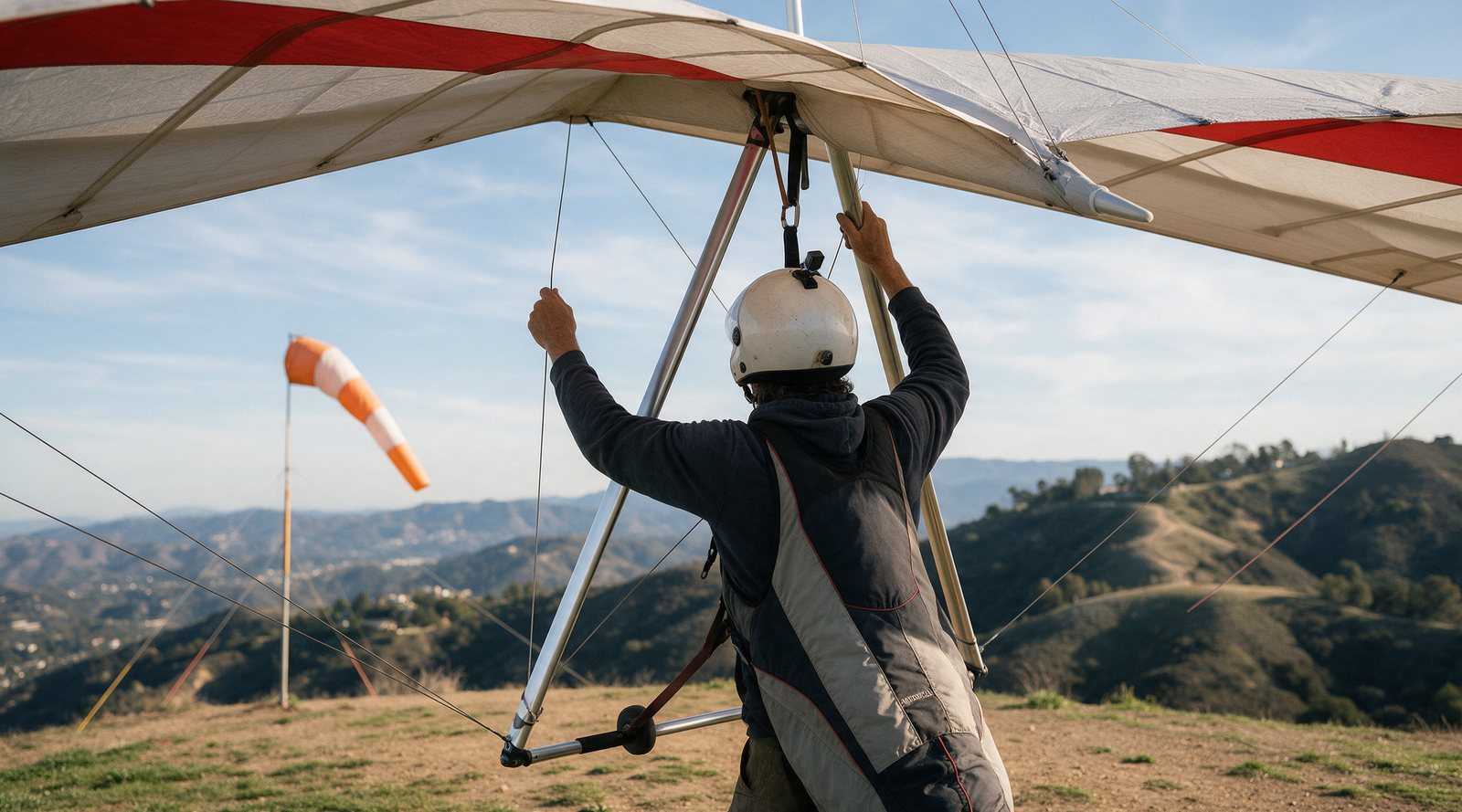
Hang gliding is not risk-free: pilots are seriously injured and killed every year,. The risk is also not random. USHPA, the national association, says most free flight accidents come down to pilot error, and published studies point to the same handful of causes: weather misjudged, low-altitude mistakes, and launches and landings gone wrong. This page sets out what the data shows, where accidents come from, and what pilots do to keep the odds in their favor.
What the numbers say
Good statistics on hang gliding and paragliding are hard to find. No one counts total flights or hours nationally, so most figures are either counts of deaths or rates per member. Here is what the sources we could verify actually report.
Fatality rates per participant
The most useful published rate comes from a 2017 study of incident reports filed with the British Hang Gliding and Paragliding Association between 2000 and 2014. It calculated yearly fatality rates per 100,000 participants of 40.4 for hang gliding, 47.1 for paragliding, 61.9 for powered hang gliding and 83.4 for powered paragliding. Of the 1,411 injuries reported, most were to the lower limbs, and the ankle was the most commonly injured joint (Feletti et al., 2017).
A rate of 40 per 100,000 works out to about 1 death per 2,500 participants per year. That figure averages everyone from occasional fliers to competition pilots, so your own risk depends heavily on how and where you fly.
US deaths reported by USHPA
USHPA publishes annual fatality reports. The two most recent on its site list (2021 report, 2022 report):
| Year | Paragliding | Hang gliding | Speed flying |
|---|---|---|---|
| 2021 | 5 | 1 | 2 |
| 2022 | 5 | 3 | 1 |
These counts are not rates, and they include some members who died while flying abroad and, in 2021, a paramotor accident and mini wing accidents listed under paragliding. USHPA says additional reports are currently unavailable while it updates its incident intake, with updates expected in late 2026 (USHPA Fatality Reports). Older accident summaries by year are on USHPA’s Accident Analysis page.
Accidents per flight at one busy site
A 2023 study of Mount Babadag, Turkey, recorded 44 accidents in 241,420 paragliding flights during 2020 and 2021, three of them fatal. Most accidents happened during takeoff and landing, but the deadliest phase was in flight. Most injuries were minor, and the lower limb accounted for 55.8% of injuries (Karakoyun and Golcuk, 2023).
The main causes of accidents
USHPA groups free flight risk into four areas: weather, collisions, equipment failure and pilot error. It says equipment failure is rare and that most accidents are attributed to pilot error, from inadequate training, poor judgment or overestimating one’s abilities (USHPA).
Weather and turbulence
Strong wind, gusts, turbulence and strong thermals cause many accidents. In paragliding, turbulence can collapse part of the wing. A forensic study of fatal accidents in the canton of Berne, Switzerland, from 2000 to 2018 found that glider collapse was the leading cause among paraglider pilots, at 36% of cases, and that the deadliest phase was mid-flight (Soldati et al., 2022).
Collisions with terrain, trees, wires and other pilots
USHPA lists collisions with the ground, trees, power lines or other pilots as a significant risk (USHPA). Deaths in the 2021 and 2022 USHPA reports include a hang glider hitting a tree on a landing approach, a speed wing colliding with a tree, and 360-degree turns flown at low altitude close to terrain.
Launches and landings
Most injuries, as opposed to deaths, happen at launch and landing (Karakoyun and Golcuk, 2023). One 2022 paragliding death followed a wing deflation just after takeoff, during the transition from running to flying, and a 2021 hang gliding death followed an aerotow launch problem (USHPA reports).
Risk-taking and smaller, faster wings
A review of injury research concluded that accidents happen because of risk-taking behavior, lack of education, or self-modified equipment (Rekand, 2012). The Swiss study found speed flying deaths involved young pilots exposing themselves to high-risk situations (Soldati et al., 2022), and several deaths in the 2021 USHPA report involved mini wings or speed wings flown low.
How pilots manage the risk
None of the following removes risk. Together they are what separates pilots who fly for decades from those who do not.
Real training with a certified instructor
USHPA calls finding a school or instructor the first step in a continual education process to minimize the inherent risks of free flight. Training covers weather, glider control, emergency procedures and the judgment to decide when not to launch. Our learning to fly guide explains the path from tandem to solo, and our USHPA ratings guide explains the limits that come with each rating.
Weather judgment
New pilots fly within published limits. Paragliding San Francisco’s P2 study guide, based on USHPA’s recommended operating limitations, tells new Novice pilots to avoid thermals averaging over 200 feet per minute and to launch only in base winds up to 12 mph with gusts no higher than 15 mph (P2 study guide). The same guide warns that dark clouds, towering cumulus and virga can signal strong updrafts, downdrafts and thunderstorms. Check forecasts before you drive to launch; our weather links page collects the ones local pilots use.
Gear that matches your skill, checked every flight
Paraglider wings are certified in EN classes A to D, and higher classes react more dynamically to collapses and demand more precise piloting. Novice pilots should fly gliders their instructor approves (P2 study guide). USHPA stresses regular maintenance and preflight inspections (USHPA). Paraglider fabric also degrades with UV exposure, so wing age and condition matter.
Reserve parachutes and helmets
Pilots carry a reserve parachute on most flights and practice deploying it. The P2 study guide lists a locked-in spiral, strong rotor and a serious glider malfunction at low altitude as situations where throwing the reserve may be necessary (P2 study guide). Researchers have also pointed to protection of the head, trunk and lower body as a way to reduce injuries (Rekand, 2012).
Staying current and flying within your rating
Skills fade after a long layoff, and site conditions change with the season. Our advice to returning pilots: start with an easy day at a familiar site, and fly with others. Site rules exist for the same reason. At Goat Rock, an H4/P4 club member must be present to open the site and can stop anyone from flying if necessary.
Learning from other pilots’ accidents
USHPA’s Accident Review Committee collects incident reports to analyze accidents and warn other pilots (USHPA). Clubs do the same informally. Sonoma Wings covers safety issues at every club meeting (about our club), and our flight reports are one place pilots share what they saw.
Is tandem hang gliding safe?
A tandem flight with a certified instructor is the lowest-risk way to try the sport, because the person flying has far more experience than any student. USHPA requires a tandem instructor to hold an Advanced (H4 or P4) rating plus the turbulence sign-off, log at least 200 hours of airtime or 500 flights, pass a written test and clinics with a Tandem Administrator, log at least 25 supervised tandem flights, and hold current CPR/First Aid certification (USHPA FAQ, USHPA Certifications). Torrey Pines Gliderport says its record includes nearly 150,000 accident-free tandem flights in the last 20 years (Torrey Pines), which is the school’s own figure.
Tandem accidents do happen. USHPA’s 2022 report lists a death during a hang gliding tandem flight given by a pilot whose USHPA membership had expired in 2015 (USHPA 2022 report). Before you book, confirm that your pilot holds a current USHPA tandem certification, and expect both of you to sign USHPA membership paperwork on the day, since the FAA exemption that covers instructional tandems requires it.
Hang gliding or paragliding: which is safer?
The British data shows similar yearly fatality rates for the two sports (Feletti et al., 2017). The risks are different in character. A paraglider can partially collapse in turbulence, while a hang glider keeps its shape but is heavier, faster and less forgiving of a poor landing. Our hang gliding vs paragliding comparison covers the differences in more detail. For what it costs to train properly and buy a reserve, see hang gliding cost.
Frequently asked questions
What is the fatality rate of hang gliding?
A 2017 study of British Hang Gliding and Paragliding Association reports from 2000 to 2014 calculated a yearly fatality rate of 40.4 per 100,000 participants for hang gliding and 47.1 for paragliding. Rates per flight or per hour are rarely published because nobody tracks total flights reliably, so treat any single number with caution.
How many hang gliding deaths are there a year in the US?
USHPA's published fatality reports list 1 hang gliding death for 2021 and 3 for 2022, alongside 5 paragliding deaths in each year and a few speed flying deaths. The lists include some US members who died abroad. USHPA says newer reports are not yet available and expects updates in late 2026.
Is paragliding safer than hang gliding?
The data does not show a clear winner. The British study found similar yearly fatality rates (47.1 per 100,000 participants for paragliding and 40.4 for hang gliding). The risks differ: paragliders can collapse in turbulence, while hang gliders are heavier and faster. Training and judgment matter more than the choice of wing.
Is tandem hang gliding safe for a first-timer?
Instructional tandems in the US are flown by tandem instructors who, under USHPA rules, need an Advanced rating, a turbulence sign-off, hundreds of hours or flights of experience, a clinic and a CPR/First Aid certificate. Accidents still happen, so check that your pilot holds a current USHPA tandem certification and fly with an established school.
What are the most common hang gliding and paragliding injuries?
Studies agree that most injuries are to the legs and arms, especially ankle fractures and sprains, and most happen at takeoff or landing. Spinal and head injuries are less common but more serious. Fatal accidents tend to happen in flight rather than at launch or landing.
Is paragliding safe to do?
Paragliding carries real risk of serious injury and death, but much of that risk is in the pilot's hands: weather judgment, flying within your rating, gear checks and staying current. A study of 241,420 flights at Babadag, Turkey, in 2020 and 2021 recorded 44 accidents and 3 deaths, with most accidents of low severity.
Sources
- Feletti F, et al. Incidents and Injuries in Foot-Launched Flying Extreme Sports. Aerosp Med Hum Perform. 2017;88(11):1016-1023 (PubMed)
- Karakoyun OF, Golcuk Y. Accidents and injuries related to paragliding on mount Babadag, Turkey. Turk J Emerg Med. 2023 (PubMed)
- Soldati FO, et al. Foot-Launched Flying Sport Fatalities in the Canton of Berne, Switzerland. Wilderness Environ Med. 2022 (PubMed)
- Rekand T. The epidemiology of injury in hang-gliding and paragliding. Med Sport Sci. 2012 (PubMed)
- USHPA: Fatality Reports
- USHPA: 2021 Hang Gliding and Paragliding Fatalities (PDF)
- USHPA: 2022 Hang Gliding and Paragliding Fatalities (PDF)
- USHPA: Accident Analysis
- USHPA: About Free Flight Aviation (risks of free flight)
- USHPA: Reporting an Incident
- USHPA: Frequently Asked Questions (tandem instructor requirements)
- USHPA: Certifications and Appointments
- Paragliding San Francisco: USHPA P2 Test Study Guide
- Torrey Pines Gliderport: Instructional Tandem Flights