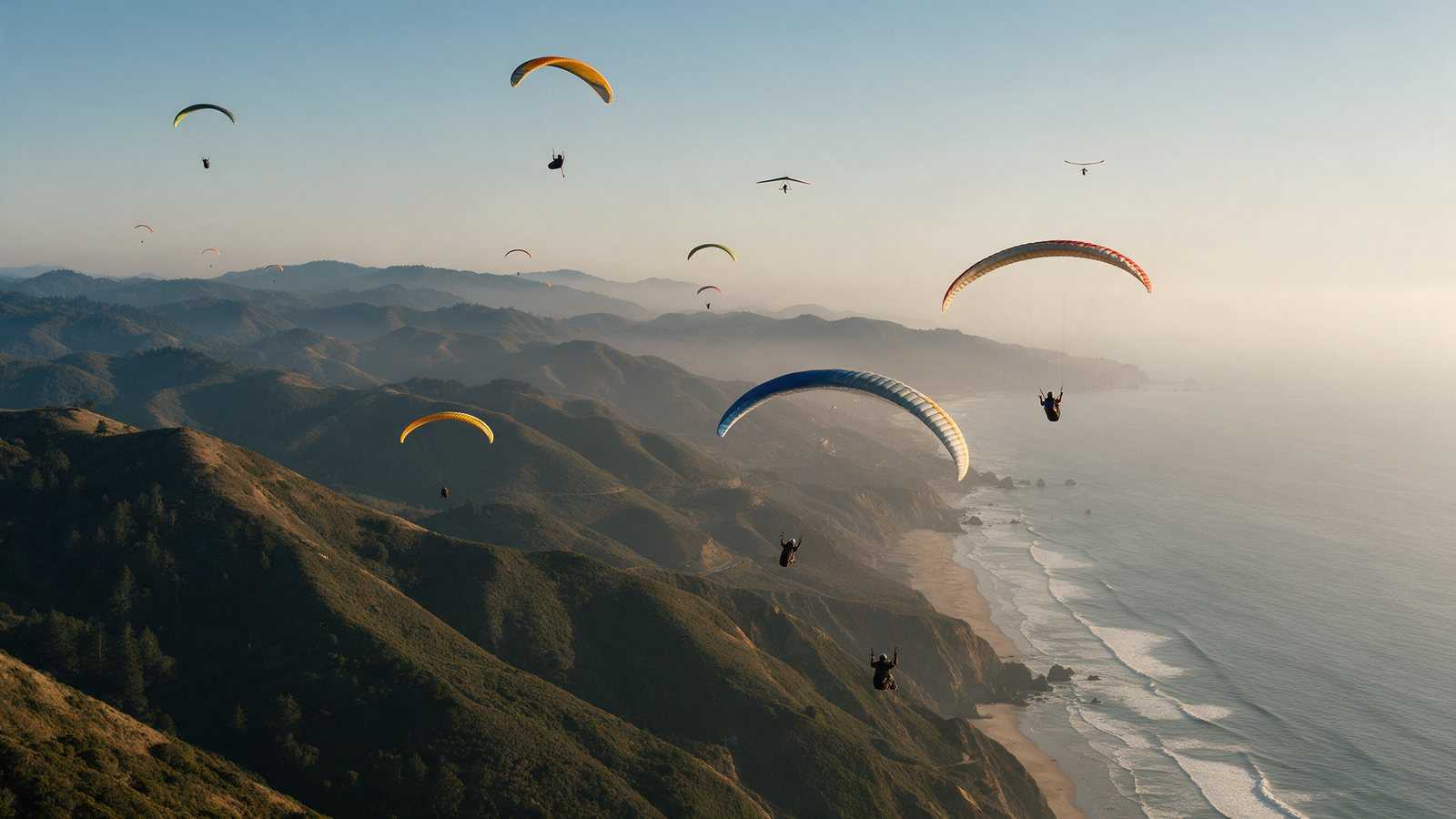
You can paraglide and hang glide all over California, from coastal cliffs in San Diego and San Francisco to the high desert of the Owens Valley. Almost every site is run by a local club or a park agency, and most ask for a USHPA rating, club membership and a site intro. Looking for paragliding near you? Below are the sites we know best, grouped by region, with the sport, typical wind, rating and managing club for each.
If you have never flown, a site directory is not the place to start. Book a tandem or lessons first (see learn to fly and our dealers and training list), then come back here once you have a rating. Our USHPA ratings guide explains what P2, P3, H3 and H4 mean, since those labels appear in every entry below.
Rules in this list were checked against the managing club or agency in October 2026. Site rules change often, so confirm with the club before every trip.
Northern California and the North Coast
Goat Rock (Jenner) - our club site
Goat Rock is a coastal soaring site in Sonoma Coast State Park, a mile south of Jenner, flown by both hang gliders and paragliders. Launch is at the Arch View parking lot and pilots land on the beach. It takes northwest through southwest wind and is typically flown January through May, with many summer evenings working for paragliders. Flying is by permit, and a Sonoma Wings H4/P4 must be present to open the site. See our Goat Rock site guide for the full rules.
St Helena (Calistoga) - our club site
Mount St. Helena, in Robert Louis Stevenson State Park north of Calistoga, is our mountain thermal site for hang gliders and paragliders. Pilots launch only from the Middle Spine launch in light northwest to southwest wind and land in a private field in Knights Valley. Spring and fall are best. It requires an H4/P4, or H3/P3 sponsored by Sonoma Wings, plus a call to the park at least 24 hours ahead. Details are in our St Helena site guide.
Hull Mountain and St. John (historic, closed)
These two Mendocino National Forest mountains were once our big cross-country sites. Hull produced a 15,600 ft altitude record in 1987, and St. John a 110-mile hang glider flight in 2004 (see site records). Both are closed as of our latest update: Hull because of road damage and an unmaintained launch, and St. John because of 2022-2023 storm damage and a launch ramp that is no longer usable. Our Hull Mountain and St. John pages keep the old guides for history. Nearby Elk Mountain is closed too.
Hat Creek Rim (Shasta County)
Hat Creek Rim is a long west-facing volcanic ridge east of Redding, flown by hang gliders and paragliders and famous for smooth evening glass-off. It is managed by the Hat Creek Pilots Association, a USHPA chapter. The club calls it a P3/H3 site with sponsorship options for P2/H2 pilots, and since 2025 every pilot must sign the chapter waiver and join annually. Summer is the main season. Read our Hat Creek guide.
San Francisco Bay Area
Mount Tam (Marin)
Pilots launch from Bolinas Ridge on Mount Tamalpais at about 2,000 ft and land on the beach at Stinson Beach. Hang gliders and paragliders both fly here under special use permits held by the Marin County Hang Gliding Association. Winter and spring are best. Hang gliders need an H3 and paragliders a P4, or a P3 with a sponsor sign-off, plus an MCHGA sticker and daily sign-in. See Mount Tam.
Fort Funston (San Francisco)
Fort Funston’s 200 ft sandy bluffs make it one of the country’s best-known ridge soaring sites, but it is for hang gliders only. The Fellow Feathers club manages flying under a National Park Service permit and requires an H3 and a club sticker. It works in west wind around 15 mph and is consistently flyable from March through September. Paragliding is not permitted. See Fort Funston.
The Stables (Daly City)
Just north of Fort Funston, The Stables is a paragliding-only coastal site on GGNRA land managed by Wings of Rogallo. It takes west-southwest to northwest wind and is usually soarable from April to October. P3 is required, or P2 with a sponsored first flight, and every pilot needs a site intro.
Mussel Rock (Daly City)
Mussel Rock, also called The Dumps, is the Bay Area’s busiest paragliding ridge, with eight or so launches along the cliffs at the Daly City and Pacifica line. No club manages it, and Bay Area Paragliding calls it unrated, but local guides suggest P2 to P4 depending on the launch. It works in onshore wind from roughly southwest through northwest, and blowback and water landings are serious hazards. See Mussel Rock.
Ed Levin (Milpitas)
Ed R. Levin County Park is the Bay Area’s training site and inland flying site for both sports, managed by Wings of Rogallo. Launches run from 40 ft training hills to the 1750 launches, with ratings from students with instructors up to P3/H3. Morning upslope and southerly wind are typical, and the summer northwest Bay breeze often ends flying around midday. See Ed Levin.
Mission Ridge and Mt. Diablo
Wings of Rogallo also manages Mission Ridge in Fremont, an H4/P4 site (H3/P3 with extra requirements) under an East Bay Regional Park District agreement, and Mt. Diablo in Mount Diablo State Park, which requires H4 or P4 and a site introduction. Both need online sign-in.
Sierra, Central Valley and Owens Valley
Dunlap (east of Fresno)
Dunlap is a foothill thermal site on Highway 180 toward Kings Canyon, flown by hang gliders and paragliders. The Central California Hanggliding & Paragliding Club runs it, and all launches are H3/P3, with H2/P2 allowed under an instructor or USHPA observer. The club lists ideal wind of 5 to 8 mph for paragliders and 10 to 12 mph for hang gliders, and warns that midday can be strong and turbulent. See Dunlap.
Owens Valley (Bishop and Lone Pine)
The Owens Valley, between the Sierra Nevada and the White Mountains, is the country’s famous big-air and cross-country area. The Bay Area Hang Gliding Club lists launches such as Flynn’s, Gunter, Paiute and Walt’s Point as unregulated, with recommendations from H3 to H4 or experienced H3. Summer thermals here are strong, launches are high and remote, and you need your own retrieve plan. See Owens Valley.
Southern California
Torrey Pines Gliderport (San Diego)
Torrey Pines is a historic cliff soaring site above Black’s Beach in La Jolla, run as a city park with an on-site school and flight operations. It works in onshore west wind most of the year. Visiting pilots need a P3 with 50 hours or an H4, and pay a $10 day fee, per the visiting pilot page in October 2026. Non-pilots can book tandem paragliding. See Torrey Pines Gliderport.
Lake Elsinore (Riverside County)
Lake Elsinore is a busy thermal and cross-country site where pilots launch from the E or Edwards on the ridge west of the lake. It works in morning east wind before the west sea breeze arrives and sets up a convergence line. The SoCal XC League calls it unregulated, with unwritten local rules and a privately owned LZ, so get a local briefing. See Lake Elsinore.
Crestline (San Bernardino Mountains)
The Crestline Soaring Society manages launches above San Bernardino, landing at the Andy Jackson Airpark. All launches are H3/P3. H2 and P2 pilots must be signed off by or under the direct supervision of an authorized CSS instructor, and visitors must join the club before flying.
Other Southern California sites
The SoCal XC League also lists Kagel, Marshall, Santa Barbara, Laguna/Horse and Palomar among its competition sites. Each has its own club and rules. Contact local pilots before visiting.
How to fly a new site safely
Every site in this list has local quirks that no web page can fully cover. A few habits that keep visiting pilots out of trouble:
- Read the managing club’s site guide and rules before you leave home, and check the date on them.
- Join or register with the club, sign the waivers and carry your USHPA card. Many sites also need a sticker, a day fee or a daily sign-in.
- Get an in-person site intro from an authorized local pilot. At Mount Tam, Ed Levin, The Stables and Fort Funston this is required, not optional.
- Learn the airspace. The FAA does not license hang gliders or paragliders, but Part 103 still limits where you may fly, and several Bay Area and San Diego sites sit under Class B ceilings.
- Walk or look at the landing zone first, and check the tide for beach landings.
- Watch a few locals fly before you launch, and pick conservative conditions for your first flight.
- Start with forecast tools you trust. Our weather links page lists the ones we use.
If you are still deciding which wing to learn on, read hang gliding vs paragliding, or start with our guides to hang gliding and paragliding. For costs, see how much hang gliding costs, and for risk, is hang gliding safe.
Frequently asked questions
Where can you paraglide in California?
California has dozens of flying sites. Well-known ones include Torrey Pines Gliderport in San Diego, Lake Elsinore and Crestline in Southern California, Mussel Rock and Ed Levin in the Bay Area, Mount Tam in Marin, Dunlap near Fresno, Hat Creek Rim in the north and the Owens Valley near Bishop. Almost all require a USHPA rating, and many require club membership and a site intro.
Where can I paraglide near me without experience?
Without a rating, the way to fly is a tandem flight with a certified instructor or lessons at a school. Torrey Pines Gliderport, for example, listed tandem paragliding at $200 in October 2026. Schools near Ed Levin and on the coast also teach beginners; see our dealers and training page for contacts.
Do you need a license to paraglide or hang glide in California?
The FAA does not license foot-launched hang gliders and paragliders, which fly under 14 CFR Part 103. In practice, nearly every California site requires USHPA membership and a pilot rating such as P2, P3, H3 or H4, plus the managing club's membership or sticker.
What is the best time of year to fly in California?
It depends on the site. Coastal ridges like Fort Funston and Torrey Pines work much of the year in sea breeze, Mount Tam is best in winter and spring, inland mountain sites like Dunlap and Hat Creek peak from spring through early fall, and the Owens Valley is a summer and fall big-air area for experienced pilots.
Which California flying sites are good for new pilots?
Ed Levin in Milpitas allows students on its training hills with an instructor and has a clear progression for P2 and H2 pilots. Hat Creek Rim's club calls it suitable for a P2 or H2 first mountain flight with sponsorship. Torrey Pines allows P2 and H3 pilots under instructor supervision. Always fly a new site with a local first.
Sources
- Sonoma Wings: Site Guides
- Torrey Pines Gliderport: Visiting Pilot
- Torrey Pines Gliderport: Instructional Tandem Flights
- Fellow Feathers of Fort Funston: Site Guidelines
- Fellow Feathers: General Club Rules (rev. 7/10/2025)
- Wings of Rogallo: Ed Levin
- Wings of Rogallo: The Stables
- Wings of Rogallo: Mission Ridge
- Wings of Rogallo: Mt. Diablo
- Bay Area Paragliding: Mussel Rock Paragliding Site Guide
- Marin County Hang Gliding Association: Site Guide and Flight Rules
- Hat Creek Pilots Association: home page
- Hat Creek Pilots Association: Visiting Pilots
- Central California Hanggliding & Paragliding Club: Dunlap
- Bay Area Hang Gliding Club: Owens Valley sites
- Bay Area Hang Gliding Club: Flying Sites, Bay Area
- Southern California XC League: Lake Elsinore Info
- Crestline Soaring Society: home page
- 14 CFR 103.7 Certification and registration (Cornell LII)