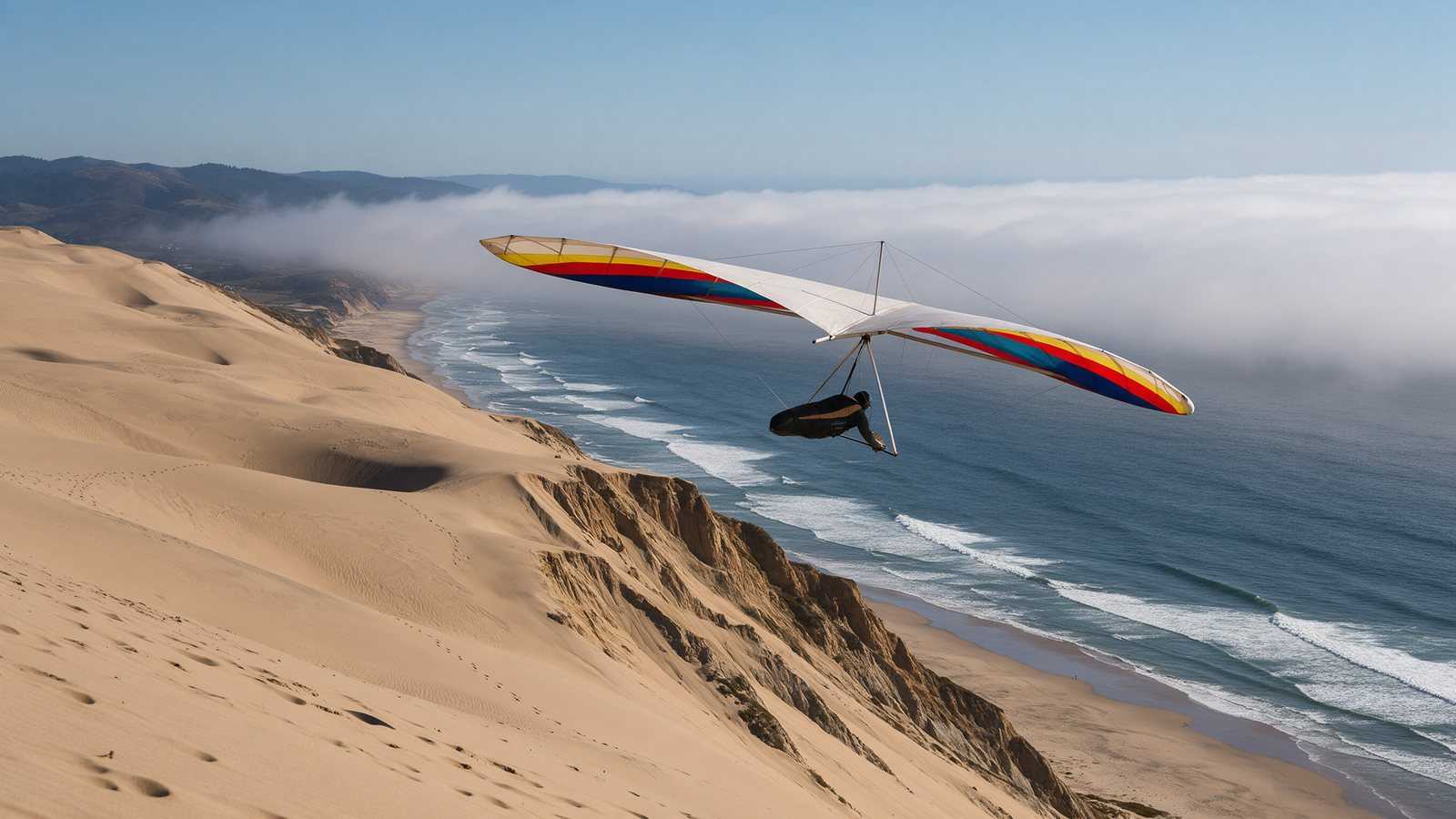
Fort Funston is a coastal ridge soaring site on the southwest edge of San Francisco, and it is one of the most famous hang gliding sites in the country. It is a hang gliding site only: you need an H3 rating, USHPA membership and a sticker from the Fellow Feathers club, and paragliding is not permitted. Spectators can watch from a viewing deck next to launch.
Overview
Fort Funston is part of the Golden Gate National Recreation Area (GGNRA), run by the National Park Service. The NPS Fort Funston page describes 200-foot bluffs and calls it “one of the premier hang-gliding spots in the country.” Flying is managed by the Fellow Feathers of Fort Funston, a USHPA chapter founded in 1973. Under a GGNRA Special Use Permit, the club issues each pilot a sub-permit in the form of a Funston helmet sticker. The club’s rules state plainly that the National Park Service has final authority over flying here.
Pilots soar the ridge in the steady sea breeze, and experienced pilots run south along the cliffs toward Westlake. It is not a training site for beginners.
Location and access
Park in the large, free paved lot off Skyline Boulevard. The Fellow Feathers site guide puts launch at about 160 ft MSL, west of the parking area, at 37.714136, -122.503003. The site has portable toilets, potable water, a setup area and optional glider storage for members. The NPS-listed hang glider viewing platform is right next to the action. Fort Funston is also a popular off-leash dog area, so expect a lot of people and dogs on the paths around launch.
Launch
Launch is a west-facing cliff launch from the designated area on the south side of the observation deck. Club rules do not allow launching when spectators are in the launch area, or when emergency vehicles are in the setup, launch or landing area (a rule added in July 2025). The site guide warns that any northerly component in the wind creates a large rotor downwind of the bush in the setup area. Expect strong turbulence walking out to launch, on launch and on landing in those conditions.
Landing
The primary landing zone is on top, in the field south of the main parking lot, which gives a 1:1 glide to the LZ. The secondary LZ is the beach below launch. Check the tide before you launch so you know the beach will be there. The club advises landing crosswind on the beach, to the north or south depending on the wind, and notes the wind at the beach can differ from launch.
Wind and season
The Fellow Feathers site guide lists:
- Direction: W, WSW or WNW. Ideal 240 to 265 degrees, acceptable 220 to 280 degrees.
- Speed: ideal 15 mph, acceptable 8 to 20 mph, with a maximum 10 mph gust spread.
The club says the site is consistently flyable from March through September, with some pre- and post-frontal days in winter. The NPS and the Parks Conservancy both note that hang gliding is especially good in March and October.
Reading Fort Funston weather and the webcam
People searching for “Fort Funston weather” usually want to know one thing: is it flyable right now? Start with the club’s own tools.
- The Fellow Feathers weather dashboard shows a live weather station labeled “Fort Funston SF,” a wind graph with average, gust and direction, and a wind map. The club notes that the station sits about 350 meters back from the ridge edge, so add 3 to 5 mph to estimate the wind on launch.
- The same dashboard links the club’s 4K livestream on YouTube and still webcams, which the club says run from 6 a.m. to 10 p.m. Watching for gliders in the air on the stream is often the quickest check.
- For the bigger picture, use a National Weather Service point forecast for the bluffs and watch the gust spread and direction as closely as the average speed.
What to look for: a west to west-southwest wind close to the club’s ideal of about 15 mph (after adding the 3 to 5 mph correction), a gust spread under 10 mph, and visibility good enough to see the ridge. Any north in the wind means rotor in the setup area. Fog can roll in fast on this coast. Our weather links page has the coastal forecast tools our club uses.
Required rating and rules
From the Fellow Feathers rules, revision of July 10, 2025. Confirm with the club before your visit.
- Current USHPA membership and at least an Intermediate (H3) rating, with a current Funston sticker visible on your helmet.
- No pilot may fly or land within one wingspan of any person on the ground. The site guide also asks for at least 25 ft from pedestrians.
- Stunt flying and aerobatics are banned from the Training Bowl north to Sloat Boulevard (bank over 60 degrees or pitch over 30 degrees).
- Pilots without an H4 need two supervised flights south of the Training Bowl before going alone, and H3 pilots need a Westlake introduction.
- From March 15 to August 15, stay at least 500 ft AGL north of the northern beach access trail to protect the bank swallow nesting area. The NPS notes bank swallows are a state threatened species that nest in these cliffs.
- Novice (H2) pilots fly only under a club-approved sponsor, in smooth wind of 15 mph or less, must glide straight to the beach and must fly a 6-foot streamer.
- Motorized, experimental and paragliding flights are not permitted. Commercial operation is prohibited, and tandem pilots need approval from the Funston Tandem Administrator.
Airspace is the rule that can close the site. San Francisco’s Class B airspace sits low over this coast, and FAA rules bar ultralight vehicles, including hang gliders, from Class B without ATC authorization. The club’s chart shows five ceiling changes between Fort Funston and Devils Slide. Learn them before flying south.
Membership was listed at $25 for the 2026 calendar year on the join page, with higher tiers that include clubhouse storage.
Hazards
- Bush rotor in any north wind, around the setup area and LZ.
- Pedestrians and dogs in the launch and landing areas.
- Tides that cover the beach LZ.
- Low Class B ceilings to the south.
- Fog and changing wind between launch and beach.
If you are new to coastal flying, our is hang gliding safe page covers how pilots manage these risks.
Paraglider pilots: where to fly instead
Paragliding is not allowed at Funston itself. Just north, Wings of Rogallo manages The Stables, a paragliding-only GGNRA site with a P3 requirement (P2 with a sponsored first flight) and a required site intro. To the south, Mussel Rock is the area’s busiest paragliding ridge.
Nearby
Across the Golden Gate, Mount Tam offers mountain flights to Stinson Beach, and the South Bay’s Ed Levin is where many Bay Area pilots train. Our own coastal site, Goat Rock, is up the coast near Jenner in Sonoma County. See the full list on California flying sites, or start with our hang gliding guide.
Frequently asked questions
Can you paraglide at Fort Funston?
No. The Fellow Feathers club rules (revised July 10, 2025) state that motorized, experimental and paragliding flights are not permitted at Fort Funston. Paraglider pilots in the area fly The Stables just north of Funston under Wings of Rogallo rules, or Mussel Rock to the south. Check each site's current rules before you go.
What rating do you need to hang glide at Fort Funston?
You need current USHPA membership and at least an Intermediate (H3) rating, plus a current Fellow Feathers Funston sticker on your helmet. Novice (H2) pilots may only fly under direct supervision of a club-approved sponsor, in limited wind and with a beach landing. Rules were checked in October 2026.
What is the best wind for Fort Funston?
The Fellow Feathers site guide lists west, west-southwest and west-northwest wind, ideally 240 to 265 degrees, at about 15 mph. It calls 8 to 20 mph acceptable with no more than a 10 mph gust spread. A northerly component creates strong rotor behind the bush in the setup area.
Is there a Fort Funston webcam?
Yes. The Fellow Feathers weather dashboard at flyfunston.org has a 4K livestream on YouTube and still webcams, which the club says operate from 6 a.m. to 10 p.m. The same page shows the club's weather station and a wind graph.
When is Fort Funston best for hang gliding?
The club says the site is consistently flyable from March through September with steady west winds, plus some pre- and post-frontal days in winter. The National Park Service notes that hang gliding is especially good in March and October.
How much does it cost to fly Fort Funston?
As of October 2026 the Fellow Feathers join page lists a pilot membership at $25 for the calendar year, with higher tiers that include clubhouse storage. There is no parking fee at the main lot. Check the club site for current prices.
Sources
- Fellow Feathers of Fort Funston: home page
- Fellow Feathers: Site Guidelines (published February 2024)
- Fellow Feathers: General Club Rules (rev. 7/10/2025)
- Fellow Feathers: Weather Dashboard
- Fellow Feathers: Join / Renew Membership
- National Park Service: Fort Funston, Golden Gate National Recreation Area
- National Park Service: Hang Glider Viewing Platform
- Golden Gate National Parks Conservancy: Fort Funston
- Wings of Rogallo: The Stables
- 14 CFR 103.17 Operations in certain airspace (Cornell LII)