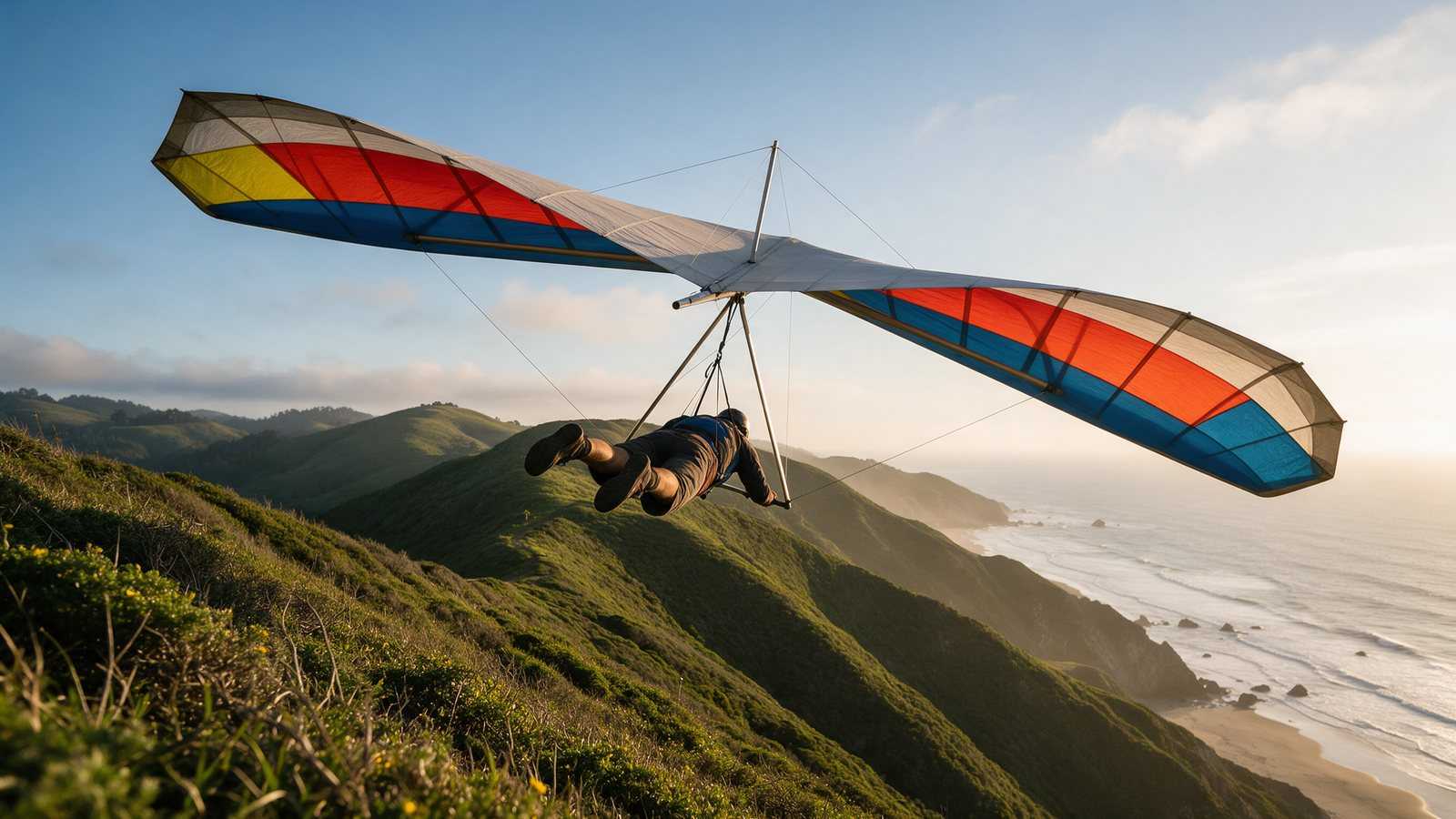
Hang gliding is unpowered flight in a light, foot-launched aircraft that the pilot steers by shifting body weight. A modern hang glider can soar for hours on rising air and glide well over ten feet forward for every foot it drops. Most people start with a tandem flight or a day on a training hill, and earn a USHPA Novice (H2) rating before flying on their own.
We are Sonoma Wings, a hang gliding and paragliding club in Sonoma County, California. This guide covers what we wish every curious beginner knew before their first lesson: how a hang glider flies, what the gear looks like, how training and ratings work, what it roughly costs, and where people fly in California.
What is hang gliding?
A hang glider is a fixed-wing, heavier-than-air aircraft with no engine. Most modern hang gliders use an aluminium alloy or composite frame covered with synthetic sailcloth. The pilot lies prone in a harness that hangs from the frame, holds a triangular control bar, and launches and lands on foot.
The name gives the setup away. You hang below the wing, and the wing is a real glider. It is always descending through the air around it, so to stay up you need air that is rising faster than the glider sinks. Finding that rising air, and using it well, is most of what the sport is about.
In the United States a single-seat hang glider falls under the FAA’s ultralight rule. 14 CFR 103.1 defines an unpowered ultralight as a single-occupant recreational vehicle weighing less than 155 pounds, and 14 CFR 103.7 says operators need no airman or medical certificate. Instead, the sport polices itself through the United States Hang Gliding and Paragliding Association (USHPA), its instructor network and its pilot ratings, which sites like ours require.
How a hang glider flies
Weight-shift control
There is no stick, rudder or flap. The pilot moves their body relative to the control frame, called a triangle control frame, or A-frame, made of two downtubes and a base bar. Shift your weight to the right and the flexible wing twists so that it rolls and turns right. Pull the bar toward you and the nose drops and the glider speeds up. Push out and it slows down. It feels intuitive within a few flights, which is part of why the training hill is so much fun.
Glide ratio
Glide ratio is how far a glider travels forward for each unit of height it loses in still air. A 12:1 glider covers 12 feet for every foot of descent. Flexible-wing hang gliders glide at about 9.5:1 for recreational wings and up to about 16.5:1 for modern competition models, and rigid wings reach around 20:1. For comparison, paragliders range from roughly 9:1 to 11:1, and a gliding Cessna 152 manages about 9:1.
That performance matters in practice. At our St Helena site, the club guide warns of a 6:1 glide out over vineyards with few safe places to land, so a glider’s real-world glide is something every pilot thinks about before launch.
Where the lift comes from
A hang glider stays up by flying in air that rises faster than it sinks. The two sources beginners hear about first are ridge lift and thermals.
Ridge lift happens when steady wind blows into a slope or cliff and is forced upward. Pilots fly back and forth along the face in that band of rising air. Coastal sites work this way. At Goat Rock on the Sonoma Coast, our club guide notes that 400 feet over launch is common, with 700 to 1,000 feet over Peaked Hill.
Thermals are columns of warm air rising from ground heated by the sun. Pilots circle inside them to climb, often thousands of feet, then glide to the next one. Linking thermals is how cross-country flights happen. A variometer, an instrument that beeps as you climb, helps you find and stay in the strongest part of a thermal. Frank Colver is credited with a variometer designed for hang gliders in the early 1970s that let pilots hear their climb rate for the first time.
Speed
Hang gliders fly faster than paragliders. Wills Wing’s placard specifications list its Novice-level Falcon 4 with a minimum-sink speed of 18 mph and a never-exceed speed of 48 mph, and its higher-performance gliders at 53 mph. That extra speed means a hang glider can handle somewhat stronger wind than a paraglider, a point the Torrey Pines Gliderport makes when explaining why spring and summer suit hang gliders there.
Hang gliding equipment
The core kit is a glider, a harness, a reserve parachute, a helmet and instruments.
The glider
Gliders are built for different skill levels. Wills Wing labels the Falcon 4 a Novice (rating II) wing and its Sport 2 an Intermediate (rating III) wing. A Sport 2 weighs 54 to 70 pounds depending on size, packs to roughly 15 to 18 feet long, and listed at $5,075 new when we checked in 2026. That size and weight is why hang glider pilots carry their wings on roof racks and usually drive to launch.
In the US, many gliders are certified under standards from the Hang Glider Manufacturers Association (HGMA). The HGMA certification FAQ describes flight tests for launch, stability, stalls and maneuvering, plus vehicle tests for structural strength.
Harness, reserve and helmet
Most pilots fly in a prone “pod” or cocoon harness. A reserve parachute packs into the harness and is thrown only in an emergency. A helmet is standard at every school and site.
Instruments and radio
A variometer and altimeter, usually combined in one unit, are the basic instruments. Cross-country pilots add GPS, and most sites expect a radio. Our Goat Rock guide lists the club frequency, for example.
How people learn to hang glide
There are three common ways in, and many students mix them. Our learn to fly guide goes into more detail.
Tandem flights
A tandem hang glider carries an instructor and a passenger. It is the fastest way to feel real altitude and soaring. In Los Angeles, Windsports flies mountain tandems from Kagel Mountain at Sylmar, launching around 3,500 feet, for $350 per person in 2026, with typical flights of 10 to 20 minutes. Under USHPA’s FAA tandem exemption, the USHPA FAQ notes that both people on board must be USHPA members, with a short temporary membership available for passengers.
Training hill and dunes
Most solo training starts low. You run down a gentle slope or sand dune and fly a few feet off the ground while an instructor coaches you. Windsports’ beach lessons at Dockweiler Beach use a 30-foot dune, keep students 5 to 10 feet up, and cost $115 for four flights or $175 for seven (2026 prices). In the Bay Area, Mission Soaring Center in Milpitas lists a four-hour single lesson at $180 and a five-lesson package at $800.
Towing and aerotow
Where there are no big hills, pilots get airborne by tow. Gliders can be towed by a stationary winch, a truck, or an ultralight aircraft (aerotow), and modern tow systems, including towing behind ultralight trikes and aircraft, spread from the mid-1980s. Mission Soaring offers high-altitude tow lessons to students who already hold an H1, starting at 1,000 feet. Tow launching needs its own training and sign-off.
How long does it take?
That varies with weather, the school and how often you can get out. Schools do not promise a fixed number of days, and you should be wary of anyone who does. Plan on many lesson days spread over weeks or months to reach Novice.
USHPA ratings: H1 to H5
USHPA runs a five-level rating system for hang gliding, with matching levels for paragliding. The USHPA Become a Pilot page lists them from H1 Beginner to H5 Master, with requirements that include minimum flights, airtime and written tests.
- H1 Beginner: you can launch, fly straight and land, but are not ready to fly on your own.
- H2 Novice: you can turn, manage your approach and fly from higher ground with supervision.
- H3 Intermediate: you have more experience and the judgment to read sites and conditions.
- H4 Advanced: experienced pilots who can fly demanding sites and, at many clubs, sponsor others.
- H5 Master: long experience across many sites, conditions and wings.
USHPA requires students to be at least 14, and 16 to hold a solo rating. Each site sets its own minimums. At Goat Rock, our guide allows H2 pilots to fly the north end only with an H4 sponsor on the ground, while experienced H3 club members can fly on their own. St Helena calls for H4, or H3 if sponsored by the club. Our USHPA ratings guide explains each level in more depth.
What hang gliding costs
Rough 2026 numbers from California schools and manufacturers:
| Item | Typical price | Source |
|---|---|---|
| Training hill or dune lesson | $115 to $180 per day | Windsports, Mission Soaring |
| Five-lesson package | $800 | Mission Soaring |
| Mountain tandem flight | $350 | Windsports (Sylmar) |
| New intermediate glider | about $5,075 | Wills Wing Sport 2 list price |
| USHPA annual pilot membership | $199 | USHPA |
Add a harness, reserve, helmet, instruments and a radio, plus travel to sites. Used gear is common and can lower the starting cost a lot, but have an instructor inspect it. Our hang gliding cost guide breaks these numbers down further.
Is hang gliding safe?
Hang gliding carries real risk, and early pioneers had a poor safety record. The accident rate has dropped sharply thanks to structured training, certified gliders and a culture of not flying when the weather is wrong. Most serious accidents involve judgment: launching in conditions beyond your skill, turbulence near terrain, or a bad landing approach.
What keeps pilots safe is boring and consistent. Train with a USHPA-certified instructor, fly a glider matched to your rating, carry a reserve, check the weather before you drive (our weather links are a good start), and respect site rules. Our club covers safety at every meeting for this reason. Read our full look at whether hang gliding is safe for a closer look at the risks.
Where to hang glide in California
California has some of the best-known free flight sites in the country, from coastal ridges to big mountain thermals. Our California flying sites directory covers them, including Fort Funston in San Francisco, Mount Tam in Marin and Torrey Pines Gliderport in San Diego.
In Sonoma County, our club holds the permit for Goat Rock at Sonoma Coast State Beach, a coastal ridge site that the club has managed under a Special Event Permit since 1982, and flies St Helena near Calistoga in spring and fall. Both have specific rating, membership and sponsorship rules, so read the site guides before you visit. Visiting pilots are welcome to come to a club meeting or join the club.
A short history of hang gliding
People were flying weight-shift gliders long before the modern sport. Otto Lilienthal built and flew controllable gliders in Germany in the 1890s and could ridge soar with them, and images of his 1892 glider already show a triangle control frame.
The modern hang glider comes from the flexible wing. On 23 November 1948, Francis and Gertrude Rogallo applied for a patent on a fully flexible kite wing, later called the Rogallo wing. The Space Foundation notes that NASA looked at the “parawing” as a way to return space payloads in 1958, and the Smithsonian describes how NASA tested a Rogallo-type wing for landing Gemini capsules from 1961, though it was never used on a crewed mission.
Hobbyists noticed how simple and slow-flying the wing was. Barry Palmer built foot-launched flexible-wing hang gliders between 1960 and 1962, and in 1963 John Dickenson in Australia adapted the wing into a water-ski kite glider. The FAI later awarded Dickenson its Hang Gliding Diploma for inventing the modern hang glider. Performance climbed steadily from the 1980s, and in July 2012 Dustin Martin flew 764 km (475 miles) from Zapata, Texas, which Wills Wing reports as the FAI-ratified straight distance record.
Hang gliding or paragliding?
Hang gliders are faster, glide farther and handle more wind. Paragliders pack into a backpack and need less space to launch and land. Both are taught through the same USHPA system and fly many of the same sites. Our hang gliding vs paragliding comparison lays out the trade-offs, and our paragliding guide covers the other wing in the same detail as this page.
How to get started
Book a tandem or a training hill lesson with a USHPA-certified school. Our dealers and training page lists Northern California schools and shops, and Wills Wing’s learn to fly page has a school finder. Ask the instructor about their rating path, how they handle weather days, and what it will take to reach H2. Once you have a rating, come fly with us.
Frequently asked questions
Do you need a pilot's license to hang glide in the US?
No FAA license is needed. A single-seat hang glider weighing under 155 pounds is an ultralight under 14 CFR Part 103, and Part 103 says operators need no airman or medical certificate. In practice most flying sites require a USHPA membership and a pilot rating, so you still need proper training.
Is there tandem hang gliding?
Yes. A tandem hang glider carries an instructor and one passenger, and it is the most common way to try the sport. In California, Windsports offers mountain tandems from Kagel Mountain at Sylmar for $350 (2026 price). Under USHPA's FAA tandem exemption, both people on a tandem flight must be USHPA members, and a short temporary membership covers the passenger.
How much does it cost to learn to hang glide?
A first lesson on a training hill or dune runs about $115 to $180 in California (2026 prices from Windsports and Mission Soaring Center). Reaching a Novice (H2) rating takes many lessons, and a new intermediate glider lists around $5,000. See our hang gliding cost page for a fuller breakdown.
What is the longest hang gliding flight?
The FAI-ratified straight distance record is 764 km (475 miles), flown by Dustin Martin from Zapata, Texas, in July 2012 on a Wills Wing T2C. The flight took about 11 hours.
How fast does a hang glider fly?
Recreational hang gliders cruise in the high teens to 30s mph. Wills Wing placards its current Falcon 4 with a minimum-sink speed of 18 mph and a never-exceed speed of 48 mph, and its higher-performance T3 at 53 mph. Competition gliders can fly faster still.
How old do you have to be to hang glide?
USHPA requires tandem and solo students to be at least 14 years old, and you must be 16 to earn solo ratings. Some schools set their own limits; Windsports, for example, asks mountain tandem passengers to be 18 or older.
Sources
- Hang gliding (Wikipedia)
- Paragliding (Wikipedia), glide ratio comparison
- Wills Wing: Learn to Hang Glide
- Wills Wing: Hang Glider Placard Specifications
- Wills Wing: Sport 2 / 2C specifications
- Wills Wing: Dustin Martin's World Record Flight
- USHPA: Become a Pilot
- USHPA: Ratings and Skills Introduction
- USHPA: Frequently Asked Questions
- USHPA: HGMA certification detailed FAQ
- 14 CFR 103.1 Applicability (Cornell LII)
- 14 CFR 103.7 Certification and registration (Cornell LII)
- Space Foundation: Parawings or Hang Gliders
- Smithsonian National Air and Space Museum: Gemini paraglider wing
- Mission Soaring Center: lesson overview and prices
- Windsports: beach lessons
- Windsports: mountain tandems
- Torrey Pines Gliderport: tandem hang gliding
- Sonoma Wings site guides (Goat Rock, St Helena)