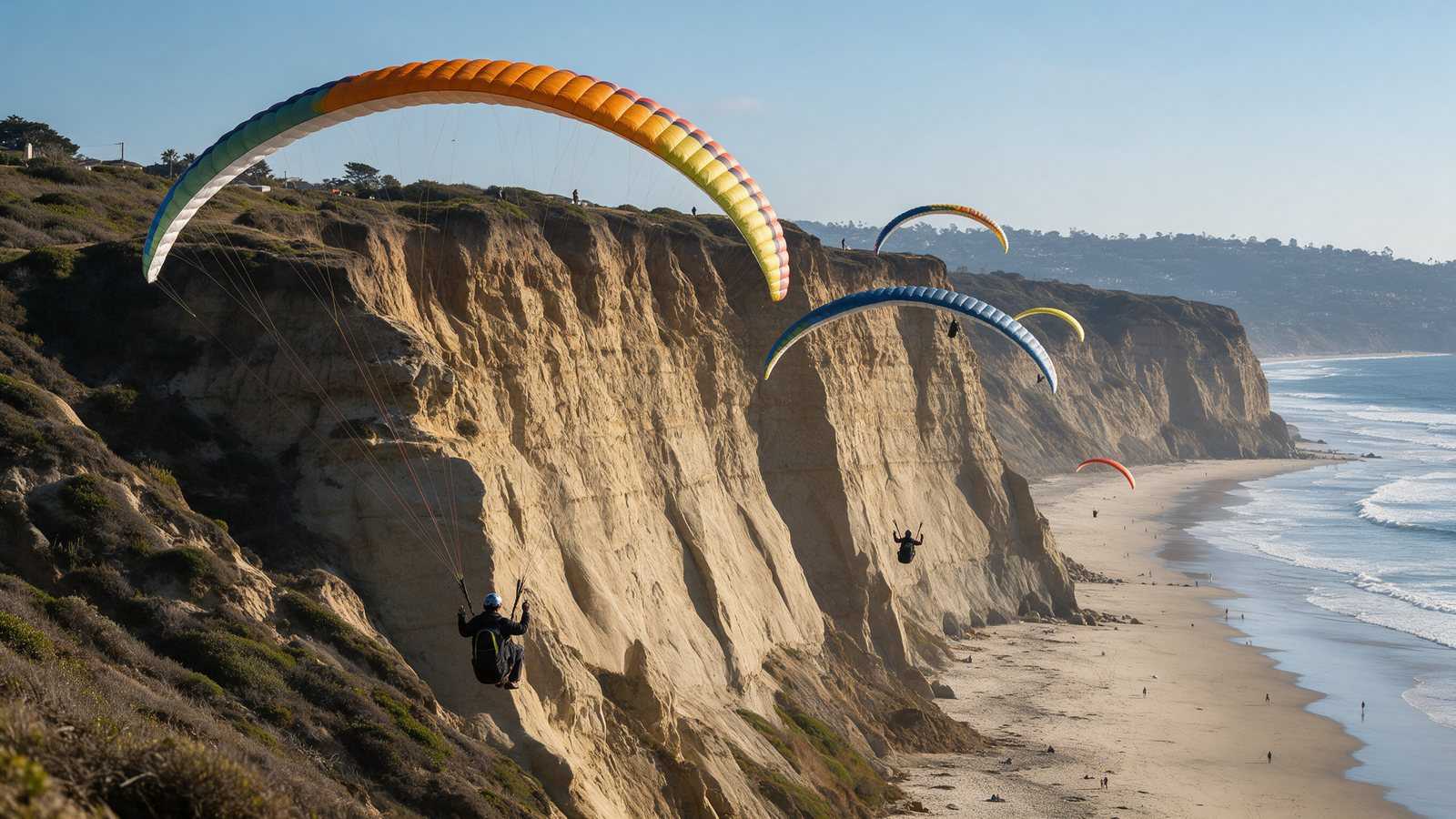
Torrey Pines Gliderport sits on the cliffs above Black’s Beach in La Jolla, and it is the best-known coastal soaring site in Southern California. Rated pilots need a USHPA P3 with 50 hours or an H4, a day fee and a check-in at the front office. Everyone else can watch from the cliff top or book an instructional tandem.
Overview
The gliderport is a City of San Diego park. The city’s planning department calls it Torrey Pines City Park, “commonly known as the Torrey Pines Gliderport,” at 2800 Torrey Pines Scenic Drive. The gliderport business on site runs the flight school, shop and flight operations, and the official gliderport website describes it as a place for paragliding, hang gliding, radio-controlled models and sailplanes.
The history is a big part of the appeal. According to the gliderport’s history page and the Historical Marker Database, Charles Lindbergh soared these cliffs in 1930, Woody Brown made the first top landing in 1936, and the site became the Army’s Camp Callan in 1941. Hang gliders arrived in the 1970s and paragliders in the mid-1980s. The gliderport was added to the National Register of Historic Places in 1993 and is San Diego Historical Site No. 315.
Location and access
The gliderport is at the end of Torrey Pines Scenic Drive, next to the Salk Institute and above Black’s Beach. The Cultural Landscape Foundation describes a mesa on top of sandstone cliffs about 350 feet high. The dirt parking lot is next to the flight area. The city lists the gliderport as closed to vehicles from 8 p.m. to 6 a.m. year-round.
Launch and landing
Launch and landing both happen on the cliff top, in front of the flight operations building. The site rules require pilots to launch and land only in designated areas, keep gliders parked clear of the landing area, and drop a kiting paraglider when others are on final.
When the wind gets light, pilots and tandems can end up on the beach. The tandem page says passengers sometimes land on Black’s Beach and hike about 15 minutes back up. For rated pilots, the site rules prohibit intentional beach landings (“sled rides”) unless the Flight Director approves, and ask you to report any unplanned beach landing to staff.
Wind and season
Torrey Pines is a ridge soaring site that works in onshore wind. The tandem page says the operation prefers west winds of 8 mph or more and claims flyable weather about 300 days a year. The hang gliding page notes that tandem hang gliding typically happens in spring, when the wind is stronger.
For live conditions, the gliderport’s weather page shows a Surfline webcam, a WeatherLink station labeled “Blacks,” a National Weather Service hourly forecast graph and a link to Thilenius live wind graphs. Our weather links page explains how we read coastal wind before a soaring day.
Required rating and rules
These requirements come from the visiting pilot page and site rules, checked October 9, 2026. Confirm them with the front office before you fly.
- Paragliders need a USHPA P3 with at least 50 hours shown in a logbook. Hang gliders need an H4.
- P2 and H3 pilots can fly under instructor supervision. The listed instructional rate is $250 per day.
- Foreign pilots need experience equivalent to Para Pro 4, 150 flights and 50 hours, plus a ground-handling check with an instructor.
- The day-use fee is $10. An annual pass is $200.
- Check-in includes your USHPA card, waivers, an 8-minute orientation video, the site rules, a whistle, a radio that can receive the gliderport’s listed frequency (151.505), and signing the pilot log.
The flying rules are specific to this busy cliff. Helmet, whistle, radio and reserve are required on every flight. Only one hang glider or paraglider may be in “the Window,” the airspace in front of the radio-control area, at a time, and you must fly straight through it while sounding your whistle. Northbound gliders have the right of way, all turns go away from the cliff, and there is no flying north of Bathtub Rock or south of Scripps Pier. The rules also say controlled Class B airspace begins at 1,800 ft MSL. The Flight Director enforces the rules under the San Diego Municipal Code, and violations can cost you your flying privileges.
If you are still working toward these ratings, our USHPA ratings guide explains what P3 and H4 involve, and learn to fly covers how training works.
Tandem flights for first-timers
Most visitors meet Torrey Pines through a tandem. As of October 2026 the tandem page lists tandem paragliding at $200 ($190 cash) for a flight of about 20 minutes. It also states that tandem hang gliding is currently not offered because the school has no tandem hang gliding instructor. There are no reservations. Flights run first come, first served, seven days a week from 9 a.m. to sunset when the wind allows, so call the gliderport at (858) 452-9858 before driving over. Our hang gliding cost guide compares tandem and lesson prices around the state.
Hazards
- The cliff itself. Turns toward the bluff or a low pass can put you into the sandstone, which is why the rules require all turns away from the cliff.
- Mixed traffic. Paragliders, hang gliders and radio-controlled models share the same ridge, and the Window belongs to the models.
- Spectators. Crowds gather at the cliff edge and near launch. You may not fly low over spectators or cars, or within 500 ft of a building.
- Beach landings. A light-wind sink-out means a landing on a public beach and a steep hike out.
- Airspace. San Diego’s Class B sits above the site, and the gliderport sets its own ceiling below it.
Nearby
Lake Elsinore, inland in Riverside County, is Southern California’s busy thermal and cross-country site; see our Lake Elsinore guide. For the full statewide picture, including our own Sonoma County site at Goat Rock, see California flying sites. Wondering which wing suits you? Read hang gliding vs paragliding.
Frequently asked questions
What rating do I need to fly at Torrey Pines Gliderport?
The gliderport's visiting pilot page asks for a USHPA P3 with at least 50 logged hours for paragliders, or an H4 for hang gliders. P2 and H3 pilots can fly under instructor supervision. Foreign pilots need experience equivalent to Para Pro 4 with 150 flights and 50 hours. Requirements were checked in October 2026, so confirm with the front office before you travel.
How much does it cost to fly at Torrey Pines as a visiting pilot?
As of October 2026 the gliderport lists a $10 day-use fee for rated pilots without a membership, and an annual pass at $200. Supervised instruction for P2 and H3 pilots is listed at $250 per day. Prices change, so check the official visiting pilot page.
How much is a tandem paragliding flight at Torrey Pines?
The gliderport lists instructional tandem paragliding at $200, or $190 cash, as of October 2026. Its tandem page says tandem hang gliding is currently not offered because there is no hang gliding tandem instructor. Flights are first come, first served and depend on the wind, so call before you drive.
Can you watch paragliders and hang gliders at Torrey Pines for free?
Yes, the cliff-top area is a city park and spectators can watch from the viewing area. Spectators are not allowed in the launch and landing areas or along the cliff edge, according to the site rules. The city closes the gliderport to vehicles from 8 p.m. to 6 a.m.
Do you need a license to hang glide or paraglide at Torrey Pines?
The FAA does not issue licenses for foot-launched gliders, which operate under 14 CFR Part 103. The gliderport, like most US sites, requires USHPA membership and a pilot proficiency rating instead. Passengers on a tandem flight need no rating at all.
Sources
- Torrey Pines Gliderport: home page
- Torrey Pines Gliderport: Visiting Pilot
- Torrey Pines Gliderport: Site Rules
- Torrey Pines Gliderport: Instructional Tandem Flights
- Torrey Pines Gliderport: Gliderport History
- Torrey Pines Gliderport: Hang Gliding
- Torrey Pines Gliderport: Weather Conditions & Forecast
- City of San Diego: Torrey Pines City Park
- City of San Diego: Night time park curfews and closures
- Historical Marker Database: Torrey Pines Gliderport
- The Cultural Landscape Foundation: Torrey Pines Gliderport
- 14 CFR 103.7 Certification and registration (Cornell LII)